
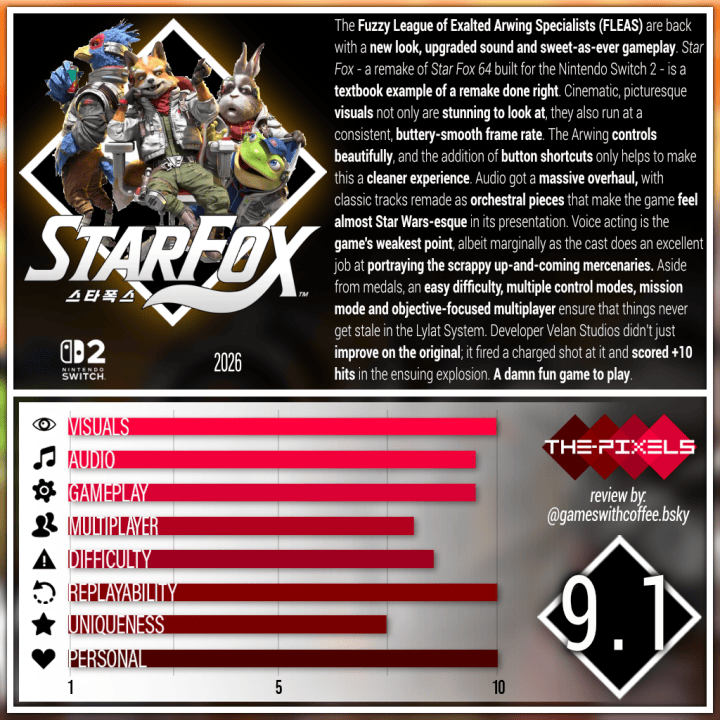
“Ancient history, Peppy. This is my Star Fox. And we’re doing things my way.”
~Fox McCloud, Star Fox (Nintendo Switch 2)
Now, I know what you’re thinking: we put up a review of Star Fox 64 a while back, so why are we doing this again? Two reasons: one, I love me some Star Fox. And two, from a reviewing standpoint, this is about as textbook an answer you can get on how to effectively execute a remake of a classic game. When Star Fox for the Nintendo Switch 2 was announced around mid-2026, I nearly lost my mind. Only for my mind to come back to me 10 seconds later as I learned that it was yet another remake of Star Fox 64 – the second in the franchise’s lifetime.
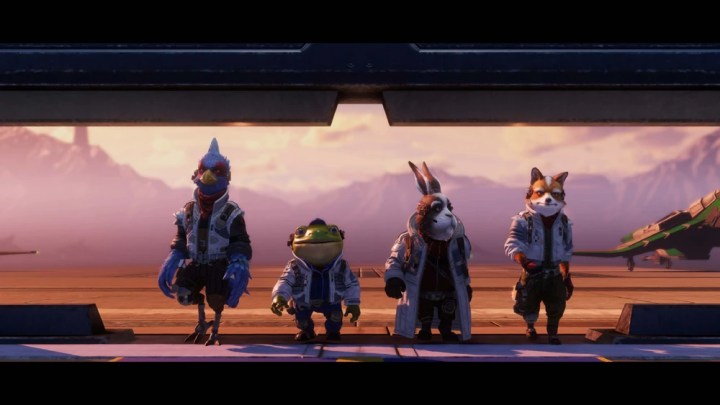
Those who know me know that Star Fox 64 is one of my favourite games of all time. So I was already on board with the remake, even though I was slightly disappointed that we were rehashing the same story once again. However, the burning question remained: how would this version of Star Fox 64 be an improvement over the original?
Well, Velan Studios, tasked by Nintendo to develop the game, didn’t just answer that question. It fired a charged shot at it and scored +10 hits from the ensuing explosion.
Absolute Cinema
Star Fox brings with it a bold new art style, with tons of realism that outright replaces the muddy textures of the original game. From rocky outcroppings, arches and cliffs to destroyed cities, desolate frontier bases and even the beautiful and deadly nebulae in Sectors X, Y and Z, Star Fox is an absolute feast for the eyes; however, it’s not just the environments that got a massive overhaul.
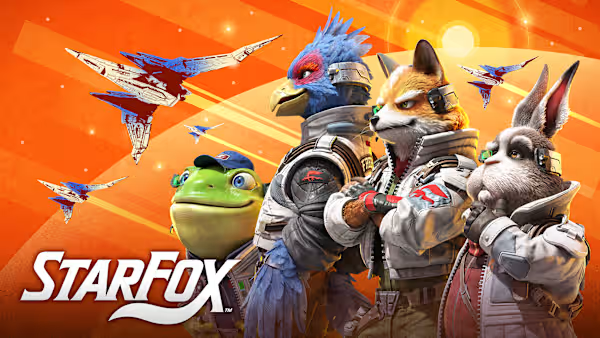
Star Fox reimagines its iconic cast and crew into a more animalistic anthropomorphized form. Fox McCloud himself looks less like his appearance in The Super Mario Galaxy Movie and more in line with, well, a talking bipedal fox. And surprisingly, it works. This version of Fox is rugged and roguish and his mannerisms reflect his appearance (more on that later). In fact, it didn’t take very long for me to get used to the new designs of the rest of the Star Fox crew, and I have to say that I dig the direction Velan Studios went with the characters.
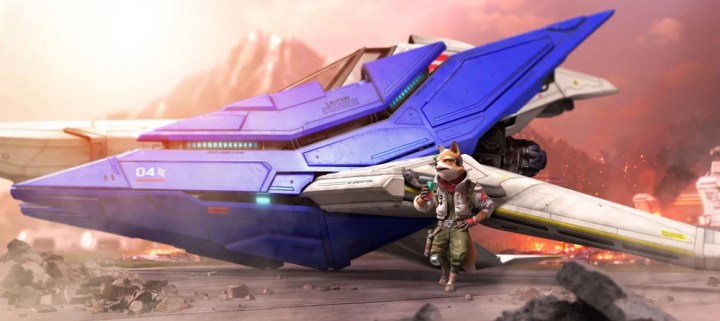
I’d be remiss if I didn’t mention the most important visual in the game: the Arwing itself. The iconic spacecraft was given its biggest glow up since Star Fox Assault. It looks sleek and streamlined in its design, with tons of details, moving parts and visual effects that just scream “high-performance assault aircraft.” I feel like I spent more time admiring the craft than I did flying it.
All Aircraft Report!
Now, I mentioned in my look at Star Fox 64 that the game suffers slowdowns when things get too busy. Star Fox for the Nintendo Switch 2, on the other hand, doesn’t suffer that in the slightest. The game plays at a perfect 60 fps, even in handheld mode. Cinematics are locked in at 30 fps, but the transition between cutscenes and gameplay is incredibly seamless.
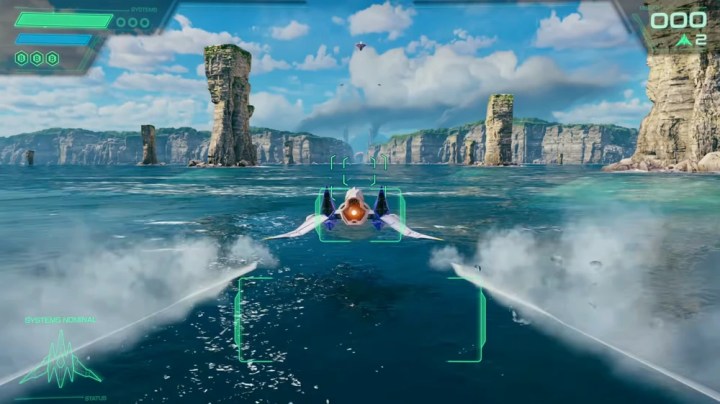
Speaking of gameplay, Star Fox is practically a one-to-one remake of Star Fox 64, which is not a terrible thing in the slightest as the original played impressively well. The Arwing controls beautifully, and the added U-Turn and Somersault shortcuts (Down and Up on the D-Pad respectively) only helps to make this a cleaner experience.
Welcome Differences
Two big things separate the remake from the original. The first is that the improved visuals help players pick out targets more clearly. And the second is that players have unlimited chances to retry with the possibility of retaining all of their laser upgrades and bombs, provided you didn’t die prior to restarting the level.
To explain this better, I’ll use Sector Z as an example. It’s notorious for being one of the more difficult levels to earn a medal in the original game. Say you come into the level through the hard route, lasers fully upgraded and a bunch of bombs in hand. You need 100 hits to medal, with at least 60 of those coming from the missiles that you have to shoot down without having your teammates steal your targets. All’s not lost as you can actually get 30 hits in at the start by taking out ten hidden boxes around the area. In the original game, they were near impossible to scope out due to the black background. The remake, however, makes those targets stand out thanks to the glow of the nebula illuminating the battlefield.
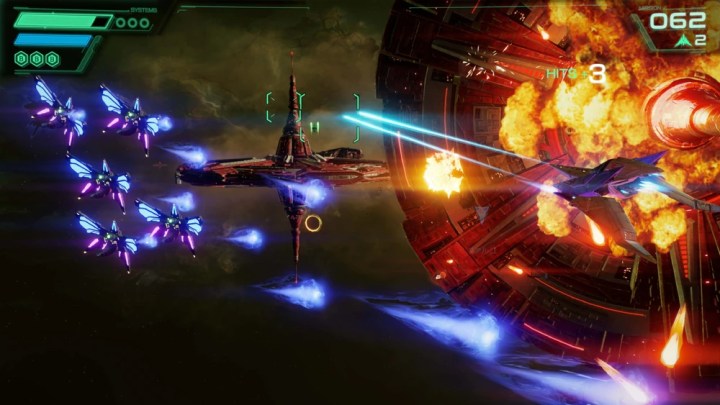
Now, say that you messed up and were just a target or two short from the medal. Not to worry, as if you hit restart, you can start the level over while retaining all of your upgrades, provided you didn’t lose a life during the level. This, to me, was the most welcome change for the remake, as it made medal hunting a much easier task.
And speaking of medals, the remake makes one other glaring change: you have to earn two medals on Venom, one for the easy path (which is incredibly difficult) and one for the hard. And Star Wolf on the hard path is no joke to deal with!
Eat Your Heart Out, John Williams
The visuals aren’t the only thing that got an overhaul, as the audio in Star Fox is incredibly well done. All of the classic tracks from the original game have been remade as orchestral pieces and it only adds to the cinematic feel to the game. From the steady, powerful drumbeats on the Main Theme, to reimagining Meteo’s 50-second loop, Star Fox feels almost Star Wars-esque in its aural presentation.
Complementing that is its voice cast, which I’d argue is probably the weaker part of the game, but only slightly. Fox in the remake sounds less like a Boy Scout and more like a fledgling leader with a bit of a chip on his shoulder. Falco’s brashness and arrogance is intact, but he also grows as a character as the story progresses. Slippy still gets into trouble and is inexperienced compared to the other pilots, but his intelligence and engineering know-how is put to the forefront. And while Rick May isn’t a part of the voice cast (RIP), the new voice of Peppy does a pretty good job of sounding like Rick did in Star Fox 64. My only complaint is that the voiced lines felt a little flat in comparison to the original, but I feel that that’s my nostalgia getting in the way.
But Wait, There’s More!
Other welcome improvements include a new easy difficulty that grants players full upgraded ships and lasers that are retained even if you lose a life. It’s a great mode for newcomers and kids alike. And on the subject of kids, there’s a great co-op control scheme with the Joy-Con 2’s that gives one player control of the ship and the other control of the guns. Kids can focus on having fun with flying the ship, while the other player focuses on blasting everything in sight. Staying with the Joy-Con 2’s, players can also play Star Fox with the mouse controls. I haven’t had too much experience with that, but it’s an interesting addition that takes advantage of the Switch 2’s mouse control capabilities.
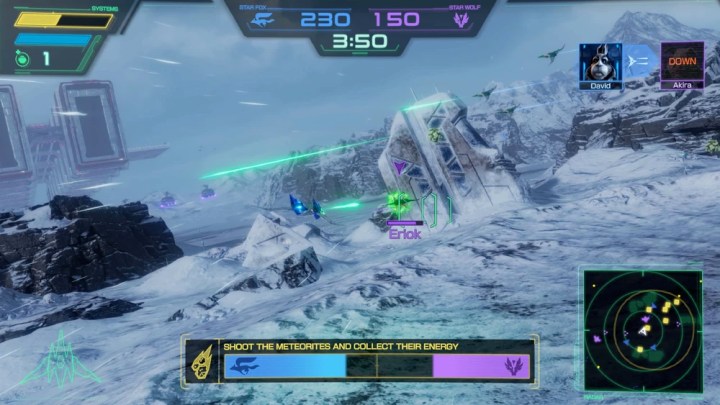
Multiplayer mode puts up to eight players in an all-range mode map. Players are put into 4v4 teams – Star Fox and Star Wolf respectively – and duke it out to complete the map’s objectives. At the time of writing, I wished there were more maps to play, but it’s been confirmed in the September 2026 Direct that three more maps will be added at the end of the month. Nevertheless, I do like the objective-focused gameplay. And not only can you play four-person split screen on one console, you can even play with bots if you don’t have enough people to play with, which is all pretty neat.
Mission Mode gives Star Fox players more chances to flex their piloting skills. Each level has ten different objectives to complete – five on Normal and five on Expert difficulty. They range from completing levels as fast as you can, to defeating certain enemies during a run, or even passing through alternate routes. You also get some unorthodox objectives, like beating Falco through the arches in Corneria, for example. It changes the way you play each level, as you’re not solely focused on taking down as many enemies as possible. I found that to be a nice change of pace.
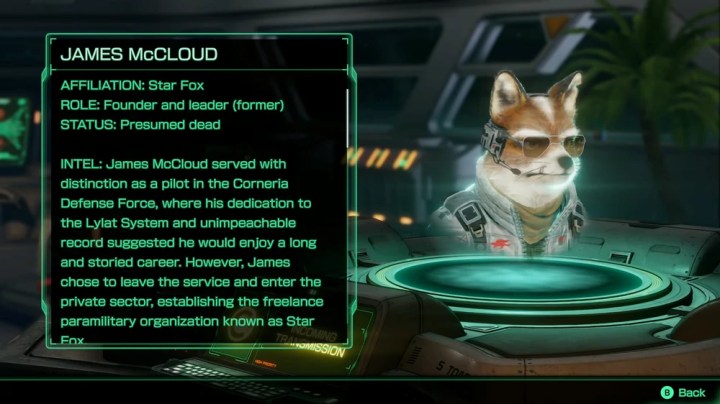
Finally, players can read up on a bunch of Star Fox lore in the Holoviewer. Entries are filled in as you progress through the game, with many of them locked behind rewards for earning medals or completing missions. What’s neat about this is that it fleshes out the story of the Lylat Wars and puts it into one place; much better than having it scattered around on the Internet, in fan translations and in headcanon. Some entries also help explain why characters are who they are: for instance, Fox’s desire to separate himself from his father may have partly been the result of him inheriting an 80-year loan his father made on the Great Fox. I mean, if I was on the hook for an enormous loan my parents made, I’d be pretty salty about it as well. All in all, the Holoviewer helps newcomers and veterans alike understand the lore of Star Fox, and gives a good idea of what direction the franchise may go in the future.
Wrapping Up
Remakes can be a tricky subject to approach. If too little is changed, it ends up looking too much like a remaster. If too much is changed, it becomes almost unrecognizable, to the point where it should be considered a brand new game, not a remake. Velan Studios manages to land Star Fox right in the habitable zone in the remake/remaster solar system. It feels exactly like Star Fox 64, but with impressive visuals and effects, quality of life improvements and more modes to play on. Most importantly, it’s damn fun to play. I easily spent a week and a half non-stop getting all the medals, staying up way too late at times just to make one more run. All in all, Star Fox is a prime example of a remake done right. I’m excited to see where the franchise goes from here.


Leave a Reply