
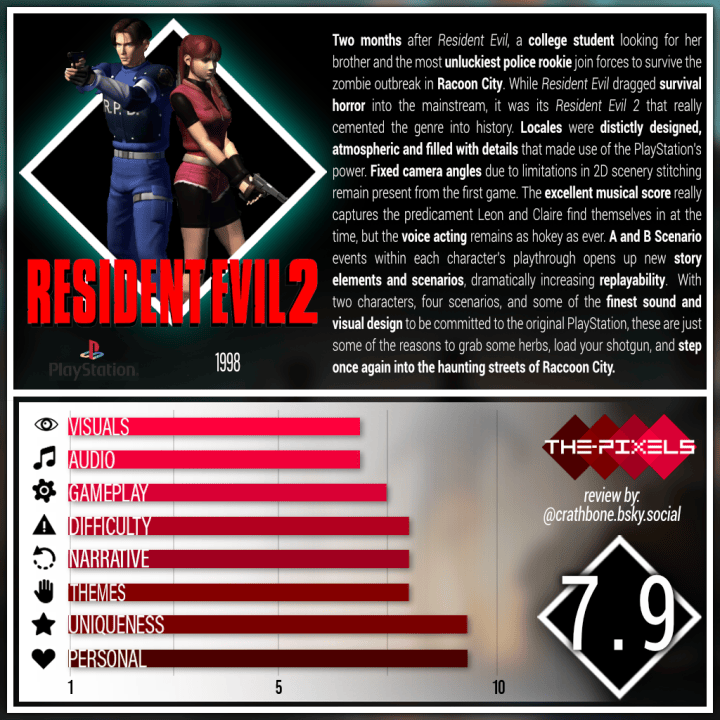
“It’s sheer perfection, my precious G Virus, nobody will ever take you away from me!”
-Dr William Birkin
Resident Evil, a franchise with many entries.
Some are genre-defining masterpieces, some are awful, bloated car crashes of games and a good few sit happily in the middle, good games in their own right even if they aren’t reinventing the wheel. This critique will be looking at an entry that is very much in the first bracket, indeed many consider it to be the definitive Resident Evil experience. It even got a full remake in 2019, which was a masterpiece in its own right.
Yes, we are looking at 1998’s Resident Evil 2.
Developed and published by Capcom, Resident Evil’s first sequel turned a lot of heads. I remember the hype for this game being absolutely off the charts at the time and many a conversation on the school playground centred around what fresh horrors the Japanese studio had dreamed up this time. For all of the hyperbole that my 12-year-old self and his classmates dreamt up, we were not disappointed when Resident Evil 2 finally hit stores in the UK.
This much anticipated sequel was released a year and 9 months after the Spencer Manor met its fate at the hands of the elite STARS team, continuing the story of the evil Umbrella corporation and its role in the destruction of Raccoon City. Resident Evil 2 was supposed to be a very different game initially, featuring many different characters and locales, yet the game’s now legendary producer wasn’t happy with the way it was developing, calling the game slow paced and boring. So, at 80% complete, Capcom canned the project and started over, placing more emphasis on the story and overall atmosphere. The canned version is widely referred to as Resident Evil 1.5 and is, in some capacity, actually playable, existing in the shadier corners of the retro gaming community.
But we aren’t here to discuss what could have been, we’re here to look at Capcom’s finished product. Does Resident Evil 2 hold up? Is it worthy of its remake? Let’s find out!
As previously stated, Resident Evil 2 comes down from the forested mountains in which the incident of the first game took place, and places the gore and nastiness right in the middle of a metropolitan area, the fictional Raccoon City. Visiting the city is Claire Redfield, a college student searching for her missing brother and former police officer Chris, who was one of the heroes from the first game, and member of the STARS special forces team.
On her way into town she runs afoul of the rampant undead, who have completely trashed the city and killed most of its inhabitants. Whilst trying to get off the streets, she meets the game’s second protagonist, Leon S. Kennedy, a rookie police officer who has transferred to the city for his first shift. Together, battling through hordes of hungry zombies, they manage to reach Raccoon City’s police station, where they begin to seek the truth about the calamity that has befallen the city and the whereabouts of Chris.
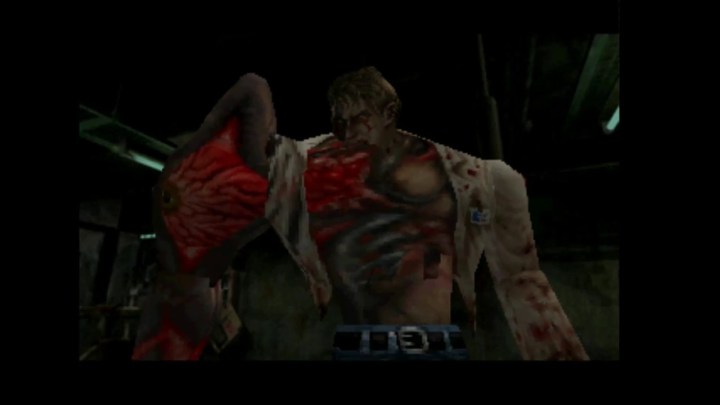
Naturally, it doesn’t take to long to discover the villain from the previous game, Umbrella Inc., which has been developing a new bio weapon, the G Virus, beneath the city itself. Faced with very few options, our heroes must stage a life or death escape from Raccoon City. There will be many obstacles along their way, including zombies, the skinless, whip-tongued Licker, a towering “tyrant” class mutant that unstoppably hunts the duo, and Dr William Birkin, a scientist turned into a monster by his own creation.
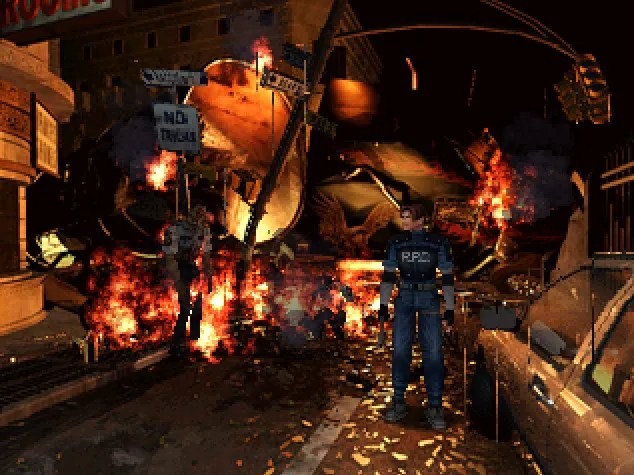
Resident Evil 2 takes the player on a journey throughout several locales including the burning streets of the city, the mysterious and (frankly absurd) puzzle-ridden police station, the sewers and Umbrella’s subterranean research facility. All of these areas are distinctively designed, atmospheric and are full of all kinds of little details that really made use of the PS1’s power.
Graphically speaking, this was the case across the board in 1998, though obviously by today’s standards, the less charitable toward retro gaming may think of it as ugly. The characters and monsters are 3D rendered polygonal models that, in quite a few cases, look almost comedically blocky by the standards of today. Yet, if one can see past this and put themselves in the shoes of the average gamer of the late ‘90s, this game does have its own particular graphical charm. The scenery is all rendered in 2D and, whilst the character models stand out against this a little, it is never jarring to see Claire or Leon interacting with their surroundings. The detailed scenery also allows for a high standard of fidelity in the surroundings. Desks are cluttered, floors and walls are splattered with claret and the burning streets of Raccoon City are covered with crashed vehicles and strewn rubbish.
Pickups such as healing items, ammunition and weaponry are rendered in 3D also, which allows them to stand out against the backgrounds with the help of a little glittering animation, helping the player better search their surroundings to find these much needed boons, though many items are hidden in cupboards or drawers that require the player to manually search each room. Examining different things will bring up a little vignette about them, like Leon mentioning that an office is trashed or that a photocopier is actually very normal and not eerie at all. These little thoughts add an extra layer of depth to the overall experience and really help with the overall immersion.
One last thing to mention here, the fixed camera angles that featured in Resident Evil persist here. Whilst this is clearly a limitation due to the 2D scenery, a way of stitching all of the different screens together whilst hiding the seams as it were, they can create some rather hairy moments that often ends in the player expending health and ammunition for something that they could not have seen coming. For instance, you walk down a long, straight corridor but fail to see the zombie stood at the midway point because it is just past the camera’s position and only appears once Leon or Claire step into the next screen. This is a classic example of the limitations of early 3D games however, a great many titles on the PS1, N64 and Saturn/Dreamcast shared these issues. Indeed, some games to this day are still plagued by camera troubles.
Resident Evil 2’s audio is, for the main part, very much up to scratch, with one or two caveats. The musical score is excellent, each piece of music really captures the situation that Leon or Claire find themselves in at the time. The opening minutes set on the streets of Raccoon City are scored by a heavy, ominous piece that positively drips with dread, mirroring the frantic speed with which the player will have to react in order to steer either survivor clumsily through the initial horde of zombies. Save rooms have a piece of music that sounds like the musical equivalent of a sigh of relief, as Leon or Claire finally catch a breath in a safe area and sort out their gear, preparing to once again delve into the nightmare just past that door.
I would be remiss, however, to wrap up talking about the music in Resident Evil 2 without mentioning the super creepy music that plays in the main hall of the police station. If I had to write down my top 10 video game nostalgia triggers (now there’s an idea!) then that track would be easily in the top 3. Memories of sitting in front of a tiny CRT television with my brother, daring each other to play the next section, are very much intertwined with that damned main hall and its music.
Sound effects are also very well done. Guns discharge with a satisfying punch, apart from the starting handgun, which has more of a sad pop. Though to be fair, the little plink noises as the shell casing falls to the floor is a very nice touch. The monsters all sound satisfyingly scary, the tortured moans of the zombies are absolutely chilling when you can’t quite see where they’re coming from and the hiss of a Licker is never a good thing to hear as it skitters down a corridor toward you. First prize for scariest monster noise though, in my humble opinion, goes to Doctor Birkin, whose enraged and twisted bellows are about as welcome to the ears as that free U2 album that somehow wormed its way onto my iTunes a few years back.
Speaking of unpleasant, let’s address the last slice of the audio pie. Anyone who has played any of the early Resident Evil or Silent Hill games will know what I am referring to. Say it with me gang… it’s the voice acting. Yes, this game has some really, really hokey voice work and, in a weird kind of way, I love it! Characters never quite seem to get their levels of urgency right, supposedly fast paced conversations are full of awkward pauses (and so much arm flailing) and the script may as well have fallen off the back of a cheese wagon. This video clip is a prime example and I can still remember every ridiculous word of this cutscene verbatim.
Whilst the voice work is legendarily terrible and campy, it does seem to pass through the realms of awfulness and reappear somewhere beyond, in a strange realm where you know everything is just the worst and yet, at the same time, you would stand up for it in an argument. Maybe it’s just the nostalgia glasses talking here, maybe I myself am completely mad.
Resident Evil 2 is without question a bigger game than the original. Whilst a single playthrough may seem about the same in length to Chris and Jill’s misadventure in the Spencer Mansion, the sequel has a trick up it’s sleeve. Whilst playing as either Leon or Claire serves up a fairly similar story, albeit with a few different characters and sections, each character also has a “B Scenario”. For instance, when the player completes the game as Leon, Claire’s Scenario B is unlocked. Scenario B follows Claire’s journey during the time frame of Leon’s Scenario A, which opens up whole new story elements and some new scenarios, as well as providing some extra endgame content. This also works the other way around, Leon’s B runs alongside Claire’s A with similar results.
Leon and Claire meet different characters throughout their journey that provide the player with some nice variation and occasionally the chance to play as another character for a while. Raccoon City is home to a few different survivors, including the enigmatic Ada Wong, a mysterious woman who teams up with Leon in order to get to the bottom of Umbrella’s mess, and a little girl called Sherry, whom Claire chooses to protect from the twisted Birkin, who seems to be relentlessly stalking her. There are a few other characters that crop up during the game. Some are good, some are bad and some are only around to be brutally ripped apart.
Perhaps the most interesting antagonist, however, is Umbrella Inc. themselves. An avaricious pharmaceutical company, they once again have tried to create the ultimate bio weapon and have, once again, somehow made a complete mess of it. Throughout the course of the story they throw various obstacles at the player, the most interesting example being Mr. X, a hulking beast in a fancy green trenchcoat that takes plenty of ammunition to put down, and keeps coming back for more. In many ways he is a blueprint for things to come, a basis for the Nemesis monster that shows up in Resident Evil 3. The series moved away from Umbrella’s direct involvement at about the point of Code: Veronica and, whilst many were glad to see the frankly ludicrous bad guys leave the stage, I was somewhat saddened by its loss. I don’t know, maybe the latter Big Bads just didn’t capture my imagination as much.

One last enemy that the game throws at you is perhaps its most abstract: its inventory system. Just like in the original, this game only allows the player to carry a very limited supply of healing items, guns, ammunition and puzzle-related items at any one time. Extra items must be stored in large chests in safe rooms, though thankfully your stashed items are accessible out of any one of these chests, eliminating a need to run around Raccoon City looking for that shotgun with a single shell that you stashed way back at the beginning of the game. Nonetheless, this system adds a real challenge to the game, as you cannot simply charge around with all of your guns and first aid sprays, instead having to deliberately leave some of your gear behind in case you find other items as you progress. There are unique items out there that increase your inventory space, but they can be easily missed.
To close, I would like to talk a little bit about Resident Evil 2’s inspirations and other works that it takes some of its ideas from. Whilst this game is undeniably Japanese in flavour, with its silly voice acting and often challenging nature, it lifts its themes and locations from the classic horror movies of Hollywood. The most obvious of these would be Night of the Living Dead, George Romero’s seminal 1968 classic that really gave traction to the zombie movie in the first place.
The visual style and themes of David Cronenburg are also evident in Resident Evil 2, mainly in the body horror design of monsters like the Licker and Birkin. Watching Cronenburg’s 1987 remake of The Fly reminded me quite a lot of the mutated creatures in this game.
Resident Evil 2 builds upon the solid foundation of the original, adding larger gameplay areas, more variety, a larger selection of enemies to kill (or be killed by) and a plot that, whilst very much derivative of many horror tropes, will certainly keep any fan of horror gaming gripped from beginning to end.


Leave a Reply