
“I need a vacation.” – T-800 Terminator, Terminator 2: Judgement Day
A Medieval Quest of Simple Proportions
Light Crusader was the first of many Sega Genesis titles that I had never encountered growing up. As an enormous Sonic fan who never really owned a Genesis growing up, my exposure to the system’s library was extremely limited. So, thank goodness for the Genesis Mini, as I would have never tried this game without it.
Developed by Treasure and published by Sega, Light Crusader was released in October 1995. Treasure, best known for games such as Dynamite Headdy, Alien Soldier and Gunstar Heroes, made Light Crusader as a 3D Isometric Action RPG title. It blends platforming, puzzle and RPG elements in a similar fashion to Climax Entertainment’s Landstalker – the precursor to one of my favourite games ever: Alundra.
As I researched the game’s development, I learned that Light Crusader was an action spinoff of the RPG series, Wizardry. Treasure really doubled down on utilizing the 3D Isometric viewpoint for this game; however, they encountered various programming and performance challenges during development. In fact, development of the game stalled after Treasure started over from scratch at one point. It was estimated by the director at the end of 1994 that the game was only 30% complete. Eight months prior to release, Sega would have shifted their focus towards marketing the title, but it was hard to do so when the game was barely functioning. Surprisingly, they made it to the finish line. Light Crusader would be the last game Treasure would develop for the Genesis, having moved on to the Sega Saturn for their next title.
A Hero Emerges
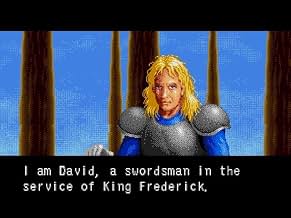
The story revolves around a knight named David, a famous swordsman in the service of the king of an unnamed land. The king invites him to the town of Green Row for a well-deserved vacation after his most recent adventures. Upon his arrival, David notices the townsfolk are agitated and learns from the king that some of the townsfolk have gone missing recently. Once he lets him know that some strange things are afoot in the court, the king instructs David to take up his sword, hunt down the missing townspeople and uncover the mystery behind their disappearance. We are also introduced to the major antagonist of the story, a sorcerer named Ragno Roke (how punny!) who has a personal vendetta against the king.
Grave Robbing and Dungeon Crawling
About 90% of Light Crusader is spent in the dungeon near Green Row. The dungeon is split into six levels. Each level could be considered a sub-dungeon as they have their own mechanics that David has to work around to progress. B1 is a standard dungeon where you have to find keys to progress. B2 has David finding orbs to break a seal leading to B3. In B3, you have to navigate a town inhabited by goblins. Players need to find a disguise to infiltrate the town, while adjusting water levels to navigate through the floor. B4 is occupied by sorcerers, who will only speak to David if he holds a Crest. B5 is a neat floor. It’s basically 8 mini-dungeons set in various time periods – from western to the far-flung future – where David must rescue eight sorcerers. The final floor, B6, is the stronghold of the final boss: a demon named Ramiah who was sealed by the old king.
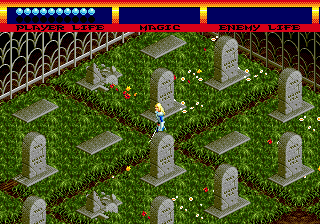
Even though the king and townsfolk give you some basic information on where to find the dungeon, no one mentions that you have to push a certain gravestone in the graveyard to access it. That is one of my main complaints with Light Crusader. I suppose that the instruction manual gives better details in that regard, but initially, I had to look up a guide for that little nugget of information.
Steel and Soul
Combat-wise, David can swing his sword and utilize magic. He also does this jumping diving stab that’s almost guaranteed to hit. It’s pretty useful when fighting bosses. He also doesn’t carry a shield – either he’s impressively confident in his swordsmanship or Treasure didn’t get around to programming one into the game. David can equip different swords, armor and gloves. Swords influence attack power, armor influences defense and gloves influence how fast David swings his sword. The best armor and gloves can be obtained by farming enemies, while the best sword – the titular Light Crusader – is given to you at the end of B4.
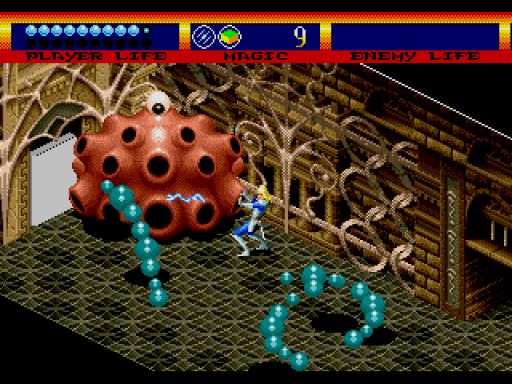
Magic is one of the main draws of the game. Instead of magic points, David has access to a finite number of elemental energy, based on Air, Water, Earth and Fire. David can use each element individually or combine them with other elements to unlock powerful magic. It’s exactly like the weapon combinations seen in Alien Soldier and Gunstar Heroes; not surprising since those games are also by Treasure.
Pickups Aplenty
David starts off with 100 health. He can extend his HP by picking up Life Up orbs in treasure chests. He recovers health and removes poison by eating food or drink. In fact, the Auto-Recover option is a nice feature in Light Crusader. With it enabled, David will automatically consume food to recover without input from the player. It really helps when you’re focused on the heat of the battle. Getting food and drinks are also quite simple too. Enemies drop them by the boatloads, you can purchase them in town and you can even trade food in the goblin town. And even if David falls in battle, you’ll return to the start of the dungeon so long as you have a Pendant in hand.
Puzzle Elements
There are certain sections of the dungeons where you have to solve puzzles to progress. The most common ones are using explosive barrels or bombs to open doors. David has to push these explosives while manipulating his environment (hitting switches, jumping on platforms, shutting off traps, etc.). Sometimes when you enter a room, you are asked to “Answer the riddle!” It just means you have to solve an easy puzzle, nothing fancy. On the other hand, if you enter a room and hear “Beat them!” It means you have to clear the room of enemies to move forward.
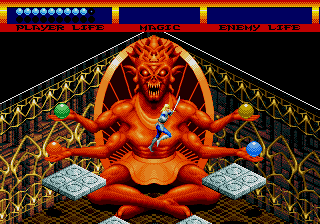
Part of David’s mission is to rescue the townsfolk. You’ll find them spread out over the dungeon floor. Some of them give you treasure, while others have information about the villain, Ragna Roke, or the demon, Ramiah, to share. It’s well worth your effort to hunt them all down.
Visuals and Audio
On the whole, Light Crusader has some nice visuals; you would never imagine that it was barely functional just as it approached its release date. David’s sprite is fairly visible, even with the isometrics blocking him from view at times. The dungeons look very detailed and there are lots of enemy varieties to swing a sword or cast magic at. The bosses are also visually impressive. There are moments of sprite flickering, but no slowdowns.
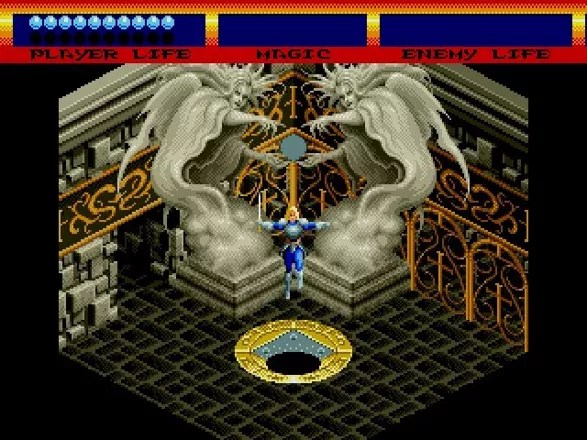
The music definitely fits the game’s atmosphere. There’s a jaunty tune for exploring the dungeons, which transitions to some eerie tones when you enter certain rooms. The town music gives off an air of calm respite. And the boss music is frenetic and harrowing. Strangely, none of it is all that memorable, but it’s serviceable enough to keep the game interesting and compelling. I do love the sound bites, especially when the game warns you that “You’re gonna die!”
Final Thoughts
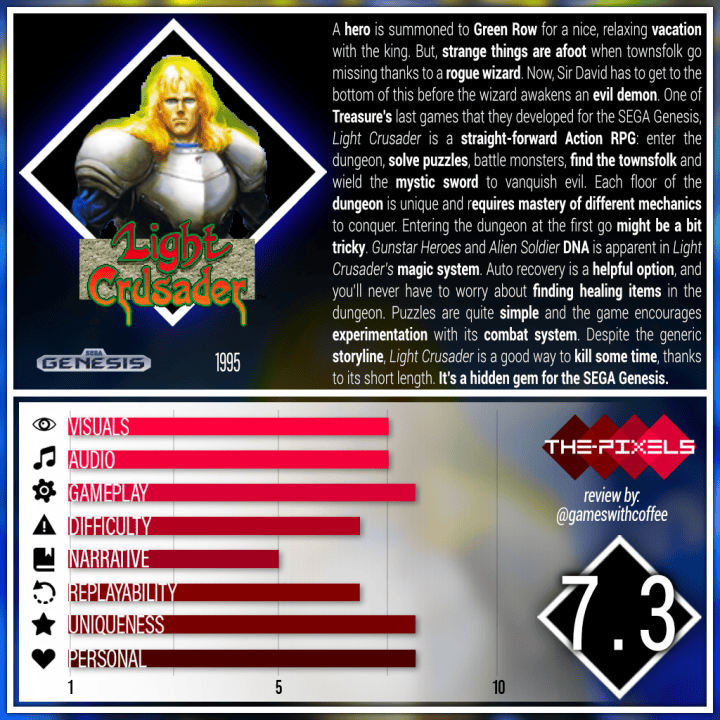
Light Crusader is an easy-going ARPG. All in all, it took me about 4 or 5 hours to clear the game. The story is pretty generic, but combat, dungeon and puzzle designs and magic experimentation makes up for that shortcoming. Despite the learning curve, I can see myself coming back to this one from time to time. It’s definitely one of the Genesis’ hidden gems, one that I recommend checking out.


Leave a Reply