
“Tell me now. Who is the monster? Is it the one who tends to our city’s lost children, or the one who challenges our safety? ~ Baron Lionel, Mina the Hollower
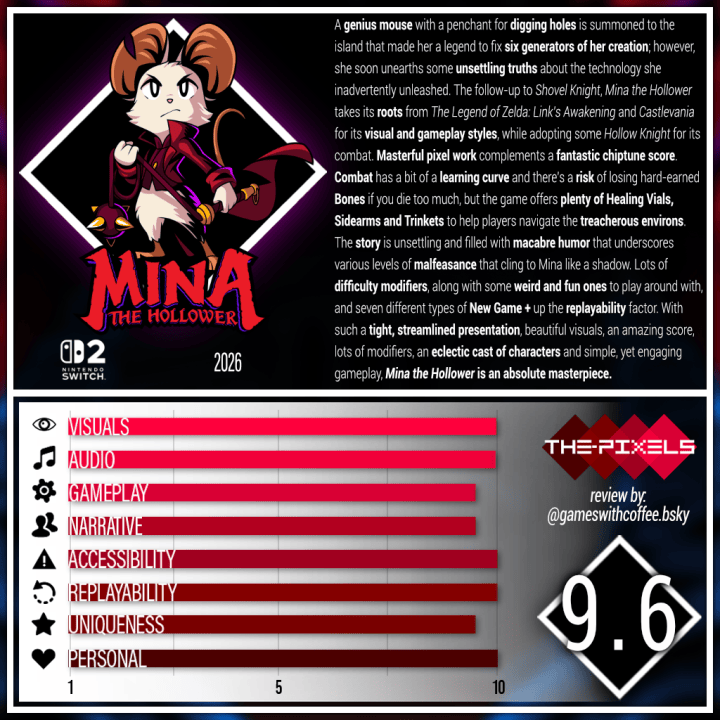
If you look up the term, “Indie Darlings,” developer Yacht Club Games would be the first example cited, along with Team Cherry. After striking the earth with their breakout game, Shovel Knight, and then plumbing the depths of its IP with numerous DLC and spin-off games, Yacht Club Games has returned with it’s newest IP, Mina the Hollower. Inspired by 8-bit top-down Game Boy adventure games, like The Legend of Zelda: Link’s Awakening, while containing elements of Castlevania and Hollow Knight, Mina the Hollower tells the tale of the eponymous character – a genius inventor, skilled adventurer and master Hollower. She travels to Tenebrous Isle at the request of the Marshal of Ossex to investigate its malfunctioning Spark Generators – which she created a decade ago – and the strange occurrences surrounding their failure. Mina the Hollower was released on all major consoles and Steam; this review will cover the Nintendo Switch 2 version of the game.
Pixel Perfection
Mina the Hollower’s visuals are marvelous to look at. Though it evokes a similar visual style as Link’s Awakening, there are intricate levels of detail in the pixel work. Each environment looks alive and well-crafted, with light and shadow dancing around in a macabre waltz for the eyes. What drew my attention, in particular, is the way the game handles the spooky elements. It’s not quite horror, but there are some moments in the game, visually, that sent chills down my spine. Without spoiling too much, one example involves a dance. It was unsettling, but excellently presented.
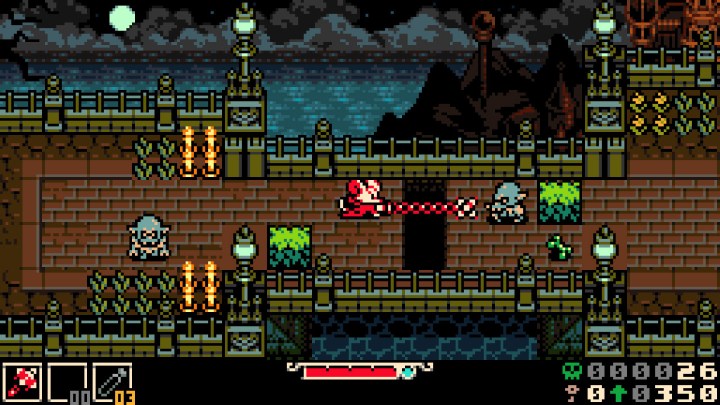
Enemy sprites are meticulously crafted and come in all shapes, sizes and states of decay. Bosses, in particular, look incredibly fierce and intimidating. Even mid-bosses and larger enemies give off imposing vibes, underscoring the fact that they, indeed, hit very hard. Yet, throughout my playthrough, I found no instances of any stuttering or slowdowns; animations are crisp, fluid and full of vibrancy.
Chiptune Goodness
Jake Kauffman, known for his work on Shantae series and Yacht Club Games’ previous entry, Shovel Knight, returns once again to provide the game’s score. And once again, the composer delivers yet another stunning opus of chiptune goodness. A Sinking Feeling (Loner’s Landing), the music in the first area of the game just after Mina shipwrecks off the coast of the Isle, is like if you got Shantae’s “We Love Burning Town” and Shovel Knight’s “Strike the Earth! (Plains of Passage)” together and they had a baby. It is broodingly atmospheric, infectiously catchy and sets the stage for the remainder of the soundtrack, which is just banger after banger from the first to last frame. The game’s sound work compliments the score, with effects matching the mood of the music. Effects are also heightened during moments of silence, where all you hear is the wails of monsters, the drips of water from the ceiling of a cave or the sound of wind blowing by.
Digging Some Holes
Mina the Hollower is played from a top-down perspective. The left stick and the D-pad buttons control Mina’s movements. She can move in all eight directions. Mina can jump with the B button, and her jump distance is roughly one tile. Mina can burrow into the ground by holding the jump button while in mid-air; this is known as Hollowing in the game. While Hollowing, Mina can travel a short distance before she pops out again. She also travels faster underground than by walking and can even Hollow in place.
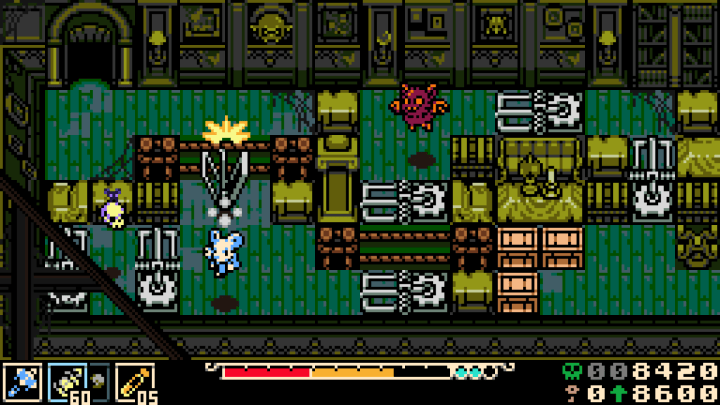
The Hollowing mechanic has incredible utility in the game. Firstly, Mina can use the force of her popping out of her Hollow to increase her jump length to two tiles – known in the manual as a Burrow Jump. It’s an important mechanic to learn early on, and the first area, Loner’s Landing, gives plenty of opportunities for players to get a feel of the Burrow Jump. Secondly, Mina can unearth buried treasures by burrowing into them. Some treasures are visible in the ground, while others are cleverly hidden. Thirdly, Mina can burrow to evade attacks and get behind enemies to strike back. This is very handy, as enemies hit pretty hard in this game. Last but not least, Mina can also Hollow into burrows to access hidden areas and her Underlab, which we’ll talk about later on.
Whips, Chains and All the Things
Mina uses her primary weapon with the Y button, while the X button is assigned to her Sidearm. There are five primary weapons to use and each weapon can be upgraded twice. Three are available from the start – the whip-like Nightstar, the powerful Blaststrike Maul and twin daggers, Whisper & Vesper, but you can only choose one to start. The other two weapons – the Battery Buster and the Guardian Casket – can either be purchased or found in treasure chests while exploring. You can also attack while jumping; in fact, some enemies and objects can only be broken while attacking in mid-air. My personal preference for most of the game was the Blaststrike Maul, thanks to its powerful charge attack and its ability to dodge roll while charging up a strike. I switched over to the Battery Buster in the late game as I started to prioritize keeping my distance from powerful foes, rather than getting up close and personal with the hammer. What I like the most is that no one weapon is better than the others. In general, it’s really up to player choice on what weapon they prefer to use.
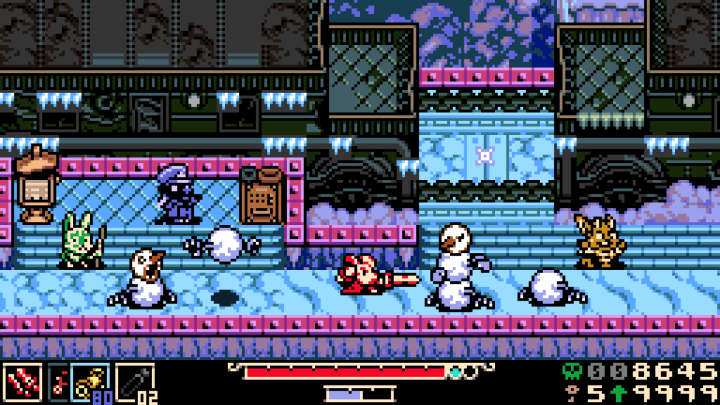
Mina can use up to 15 different Sidearms, some of which act similarly to the sub-weapons in the Castlevania series, like the Gyro Daggers or the Volt Hatchet. You also have some really neat ones, like the teleporting Recall Disks or the Drill Driver, which can act as an air dash if used correctly. Initially, you can carry only one Sidearm, but you can carry two of them by purchasing a permit and swap between them by pressing R. Sidearms cost Joules to use. You can reliably find Joules by breaking candles, although enemies sometimes drop them too. You can also expand your maximum Joules by collecting Joule Boxes.
Plasmatic
If Mina successfully hits an enemy while she’s hurt, a portion of her lost health fills in with yellow. This yellow bar represents Plasma. By drinking one of her Plasma Vials, Mina can restore her health relative to the amount of Plasma in her health bar, and is done so by pressing A. Initially, she can carry up to three vials and can expand her storage by finding/purchasing Vial Pouches. Mina can also expand her health by collecting Health Roses – an interesting nod to Pipistrello and the Cursed YoYo, which uses the same collectible.
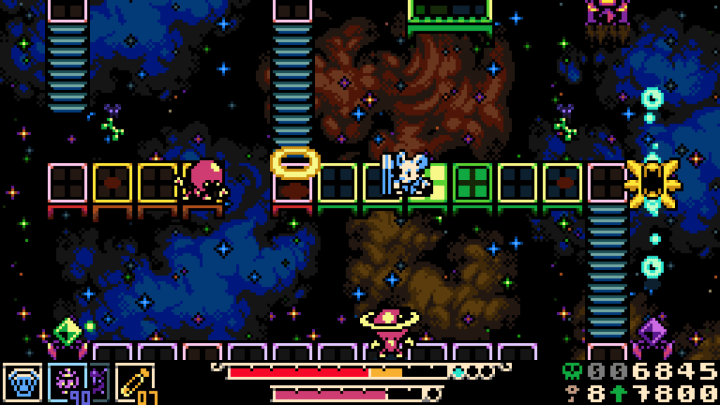
The plasma vial mechanic adds a lot of tension during combat and forces players to make split-second decisions based on various scenarios. If you’re low on health, do you risk striking enemies enough to fill up your plasma meter for a big heal? Or do you heal whatever you have in your meter, wasting a vial while you recoup your bearings? You also have to take into account that there’s a slight delay involved with drinking vials, plus you’re completely defenseless while drinking it. And to top it all off, if you’re hit mid-drink, you not only lose out on healing, you also waste a vial in the process. So, players have to account for their surroundings and timing to heal up.
Some Trinkets affect plasma and healing; The Plasma Funnel allows Mina to quickly drink and heal up and prevents her from losing vials when struck while healing. The Plasma Jug earns bonus Plasma on hits and allows Mina to overfill her Plasma gauge. This particular Trinket is great for players that aren’t very confident in their combat or platforming skills, as they can stock up on Plasma before a big fight or a tough, pit-filled room.
A Girl’s Best Friend
Trinkets are neat items that grant Mina passive effects when equipped. There are 60 Trinkets to find and Mina can equip up to six of them by collecting Trinket Bags. The game stresses that you can complete the story without using any Trinkets, so they’re really optional and helpful items that further enhance gameplay and unlock builds. Some Trinkets affect attack and defense stats, some help with burrowing and some prevent environmental and pit damage. There’s even a secret transformation if you collect and equip six specific Trinkets and drink a vial. It’s pretty… beastly. All in all, Trinkets allow players to play the game how they like, provided that they find them first. You can purchase Trinkets in stores or find them in special Trinket Chests.
Them Bones
Bones are the primary currency on Tenebrous Isles, which fits in with the game’s macabre theme. Mina can find Bones by defeating enemies, striking objects and burrowing underground. Bones come in different denominations, from tiny round bones worth 1 Bone, to massive tusks worth 1000 Bones.
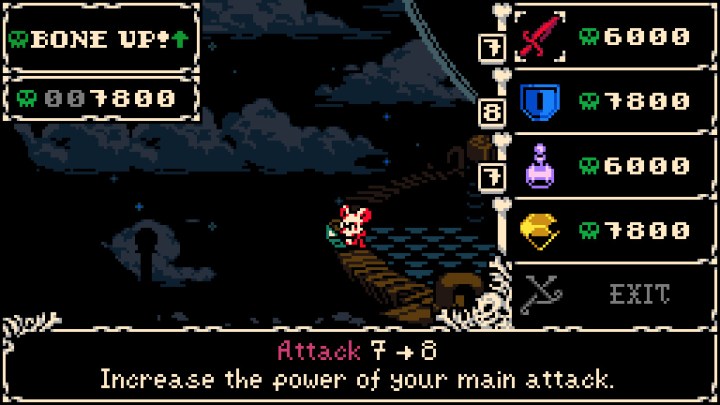
Bones are used both to purchase items from merchants and to Bone Up. If you’re familiar with Zelda II: The Adventure of Link, then you’ll recognize the Bone Up mechanic in Mina the Hollower. Essentially, when Mina collects enough Bones (represented by the counter underneath her collected Bones on the HUD), she can Bone Up to either increase one of her stats – Attack, Defense or Sidearm – or convert the Bones into a Bonestone for later use.
Bonestones are highly useful, as the player loses all their collected Bones when they die without a Spark in hand. But, you’ll never lose Bonestones upon a Sparkless death. You can use Bonestones to purchase items and to Bone Up. Players can also find Bonestones in treasure chests. To convert Bonestones into Bones, you use the Bone Sinterer in your Underlab.
Sparks of Life
While Mina the Hollower plays out like Link’s Awakening, its combat feels fairly close to Dark Souls or Hollow Knight, in that the combat is heavily dodge-dependent. Enemies – especially in the first third of the game – hit pretty hard, so it’s crucial for players to study enemy patterns and determine optimal times to heal and attack.
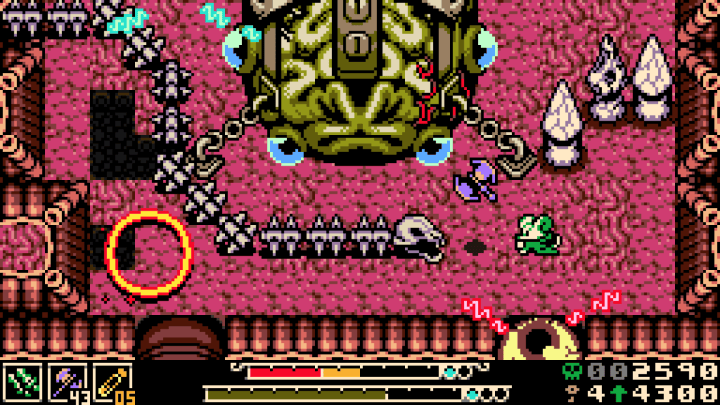
Whenever Mina falls in battle, she leaves behind a Spark and returns to the nearest Underlab. If she’s felled by an enemy, the Spark gets absorbed and occupies that enemy’s Spark slot. Defeating the enemy recovers her Spark. If she dies from environmental damage (pits, floor hazards, etc.), then the Spark just hovers in place, waiting to be reabsorbed. Mina loses all of her Bones if she dies again without a Spark in hand. The same happens to The Knight’s Geo when they die without recovering their Shade in Hollow Knight. In Silksong, Hornet can store her rosaries into strings for safekeeping, while Mina has access to her Bonestones to fall back on if she loses all her Bones. It’s interesting to see how both Yacht Club Games and Team Cherry operate similar mechanics for their games.
Mina can expand her Spark capacity by collecting Spark Containers, and there are even Trinkets that either augment her Sparks, or protect her Bones if she suffers a Sparkless death.
The Underlab
Mina’s Underlab serves both as checkpoints and as her base of operations. Denoted as a purple burrowing spot that turns gold once you walk over it, players are encouraged to burrow into each Underlab they see, as Mina will start out at her most recently burrowed Underlab whenever she dies. Say you last used the Underlab in the Queensbury Crypt and you’re currently exploring the Backwaters leading to Nox’s Bayou and you neglect to burrow into the Underlab there. When you die, you’ll be sent right back to the Queensbury Crypt, meaning you’ll have a tough time backtracking to where you were previously. That’s why it’s important to remember to burrow into your Underlab whenever you can.
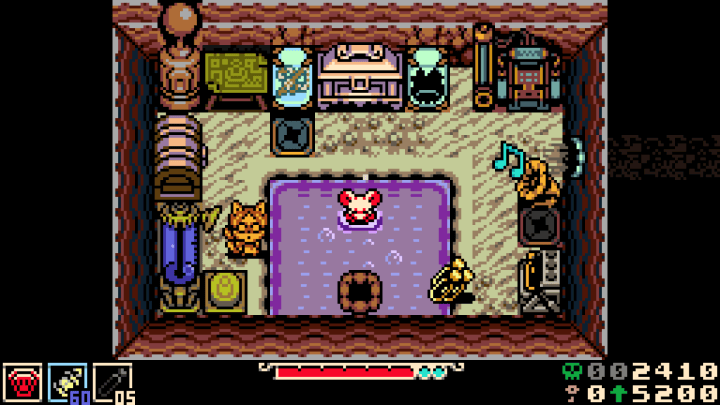
Aside from the Bone Sinterer, Mina can also change her current weapon. She can upgrade her Underlab by visiting the Hollower’s Guild in Ossex. Upgrades include, but are not limited to, a map of the island, a training room, a Sidearm storage unit and you can even modify the Underlab’s appearance to suit your tastes.
Who’s Really the Villain?
*Spoilers abound, beware!*
Mina the Hollower’s story is a great interpretation of the phrase, “The road to Hell is paved with good intentions.” Mina’s discovery of Spark technology ten years prior to the game’s story ushered in an industrial revolution. That revolution would not come to fruition without the help of her benefactor, Baron Lionel; the charismatic, deep-pocketed ruler of Tenebrous Isle who financed the construction of the Spark Generators. Little did she know that her miraculous discovery would have a dark side to it, as Sparks and the Generators themselves caused heavy alterations to the local flora and fauna around where they were installed. Monsters appear, pollution and decay run rampant and the dead have come back to life.
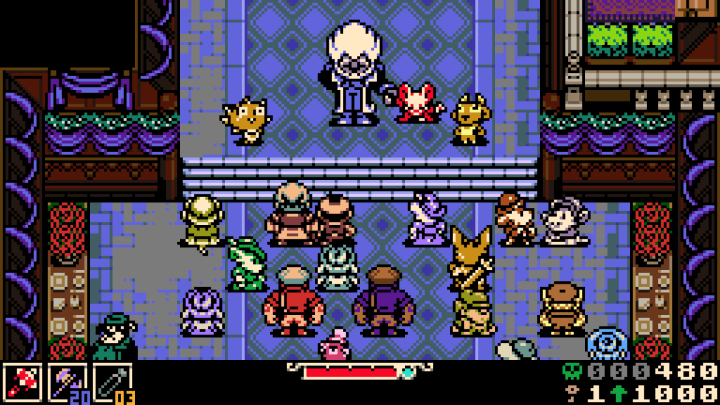
Thorne, the former Marshall of Ossex and a major antagonist in the game, opposes Mina’s quest to repair the generators. He sent her a letter summoning her to the island to help fix the problem, only for his tone to change as he ushers in a violent rebellion against the Baron due to an apparent fallout between the two. Over the course of the game, he tries to convince Mina to outright destroy the generators before they cause more harm.
It’s not until the final generator is repaired when the Baron shows his true colours. He forcibly mutates Thorne after deceiving him, and then accuses Mina of various crimes and sins against the populace on her quest to repair the generators. Hilariously enough, most of those “crimes” and “sins” committed are from actions players do in most games: breaking candles and lamp posts for items, speaking to certain individuals, stealing things and making reckless or questionable choices. All of this was to further ensure that Spark technology would persist with him being at the centre of it all, while spreading its influence – and its negative effects – to the world. I must say, I really did enjoy this twist.
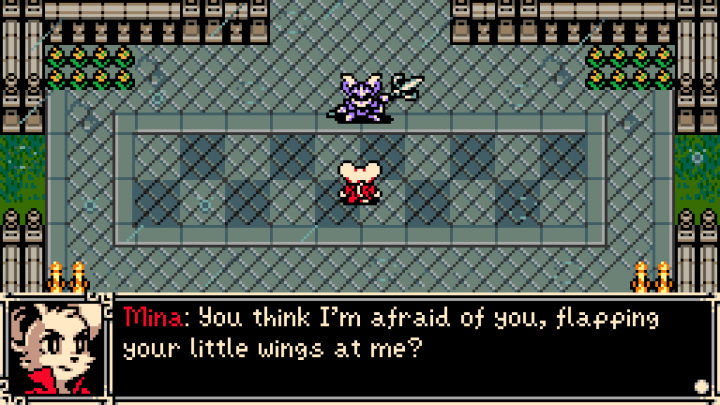
The game’s default ending also shows the fallout from the final battle: riots in various enclaves, Hollowers being hunted down with their guild destroyed and nature itself healing as the flora and fauna return to normal. But there also exists an alternate ending that can be obtained if Mina isn’t accused of any crimes. Getting this ending is tricky, but doable, particularly in a New Game + or with modifiers enabled.
Accessibility And Feats Of Derring Do
Lastly, we’ll touch on Modifiers, Feats and New Game +. On the subject of Modifiers, where do I begin? Mina the Hollower has an insane number of modifiers that alter the game in various ways. You have standard ones that make the game easier or harder, like higher/lower health, damage received/taken, no pit damage, etc., you have mods that mess with visuals and sounds, and finally, you have some weird, funny mods, like having characters speak in Victorian English. Enabling most mods will disable Feats – optional achievements that are fun, yet challenging to obtain – though some difficulty increasing mods will keep them in place.
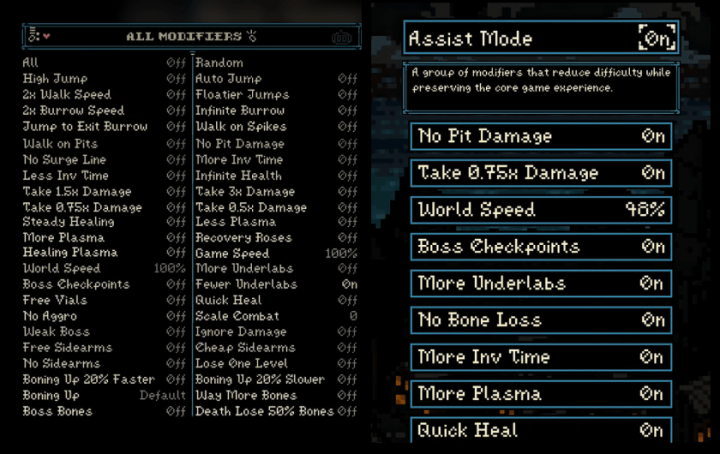
The game is even kind enough to group several modifiers under one catchall modifier toggle. For example, enabling Explorer Mode activates a bunch of mods that make the game much easier. Its description even encourages players to enable this mode to experiment and have fun with its various features. There is even a catchall mod that makes the base game only slightly easier – perfect for those frustrated with the base difficulty and who yet still crave some challenge. There’s also a Too Many Modifiers toggle that does exactly as described – enable ALL mods.
New Game + (abbreviated to NG+) operates on some interesting rules. There are 7 NG+ instances that add certain things to the game, such as randomized items/Sidearms/Enemy Stats, mirrored environments, harder enemies, fewer Underlabs and stat cap increases. On the first instance of a NG+, for example, players will keep their collectibles, but the enemies will be harder, there will be fewer Underlabs to find and your level caps increase to 15. On completion, players can play a second NG+ where your collectibles are reset, the world is flipped horizontally and caps increase to 19. This cycles up until the 7th instance, for which your level caps from that point on will keep rising until it hits 98.
Final Word
Mina the Hollower, simply put, is one of the best games I’ve played in 2026, and I’ve played a lot this year. It took a long time for its release, but Yacht Club Games knocked it out of the park with this one. With such a tight, streamlined presentation, beautiful visuals, an amazing score, lots of modifiers, an eclectic cast of characters and simple, yet engaging gameplay, Mina the Hollower is a fantastic follow-up to Shovel Knight; an absolute masterpiece, in this writer’s opinion. It’ll be interesting to see what Yacht Club Games comes up with next.


Leave a Reply