
Enter at your own peril! Past the bolted door where impossible things may happen, that the world’s never seen before!
~Dexter’s Laboratory: End Credits
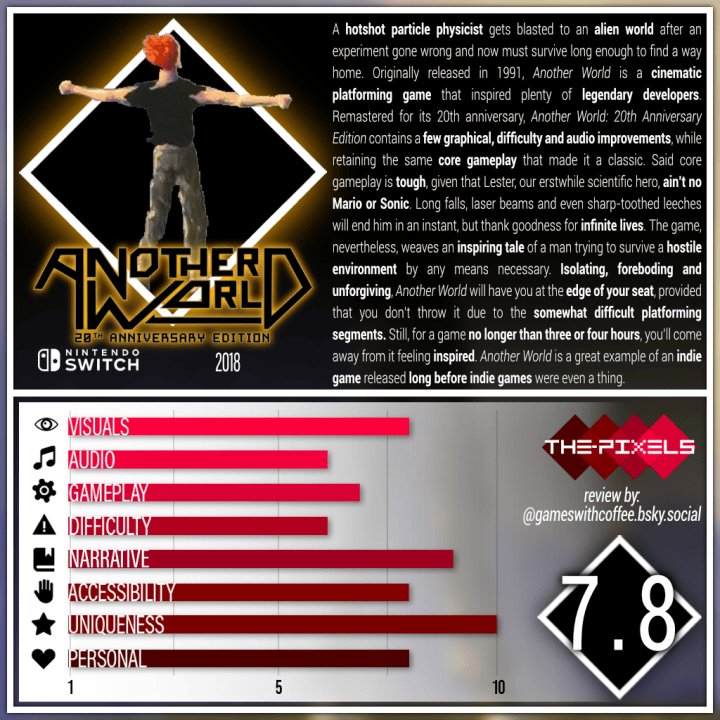
When you look into a list of iconic cult classics in video games, Another World is at the forefront. A game that inspired the likes of Hideo Kojima, Fumito Ueda and Suda 51, Another World’s cinematic approach gave it an almost indie-like quality at a time when the term indie didn’t even exist. Initially released for fourth and fifth generation consoles, as well as MS-DOS, Another World was ported to modern consoles for its 20th anniversary in 2018, and is the subject of today’s review.
This Ain’t Kansas
The game stars Lester Knight Chaykin, a scientist specializing in particle physics, working in his desert lab somewhere on Earth. During a routine experiment involving a particle accelerator, an errant bolt of lightning strikes the lab and overloads the particle accelerator. Instead of violently exploding, the resulting energy engulfs Lester and transports him across the universe to a mysterious – and dangerous – world. As Lester, the player must navigate this world and find a way back to Earth, while trying not to die in the process.All of this is presented in visually stunning (for its time) cinematics.
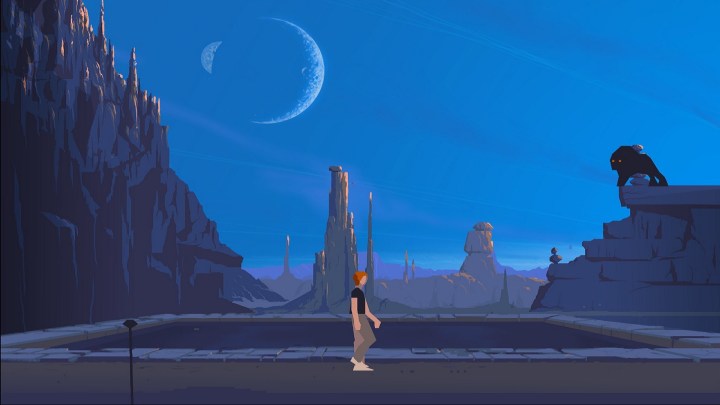
For its 20th anniversary, players are given the ability to switch between the classic look and a remastered, modern look at any time during gameplay, which I appreciated. The animations of all characters, from the tiny, death-dealing slugs at the beginning, to the beasts and aliens and even Lester himself, are breathtakingly fluid thanks to the rotoscoping techniques employed in its development. For the remake, the animations and backgrounds were further refined to take advantage of the upgraded hardware capabilities of modern systems. The Switch version in particular is extremely smooth, whether you play it docked or in handheld mode, and there is no significant lag or slowdown experienced in the visuals while playing it.
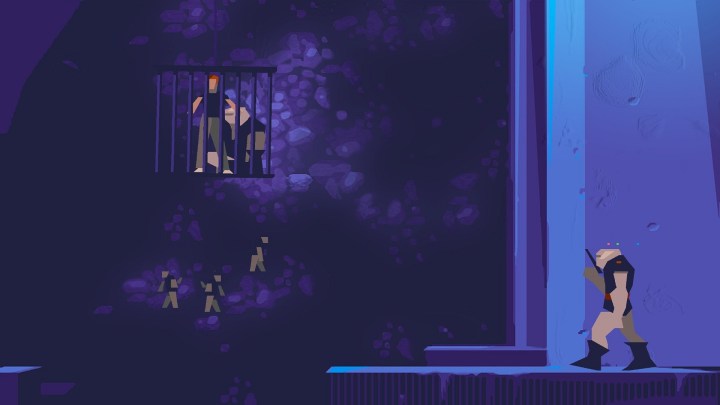
I switched between the modern and retro graphics often to see the differences between each and I found that the retro graphics actually brought on a more isolating atmosphere than the modern graphics did in certain areas, such as the caves. The graphical remastering, however, gave the game’s visuals more depth, both by adding subtle details into the background and by smoothing the character models to make them look less pixelated. To me, it felt like the alien world Lester found himself in was alive and real. If I had picked this up personally, not realizing the historical importance of this game, I would have thought that this was an indie title developed recently based on the way it looked.
Rotoscoping
Speaking of rotoscoping, this is a technique used to develop the visuals and mechanics for Another World and other games similar to it, like the original Prince of Persia for the Apple II computer. Games like these are considered cinematic platforming games, a platforming subgenre that uses a combination of realistic cinematics and traditional platforming mechanics limited to human athletic ability and basic physics for its presentation. During development, an animator utilizing rotoscoping techniques uses live footage and traces over it frame by frame so as to create fluid motion in their spritework. All of this was done using computers back in the 90’s, but in earlier times, one would have to use a projector with a transparent easel to trace the projected image on. Rotoscoping itself is a precursor to motion capture, of which most developers migrated to in the mid-to-late 90s during the transition to 3D.
Cinematic Platforming
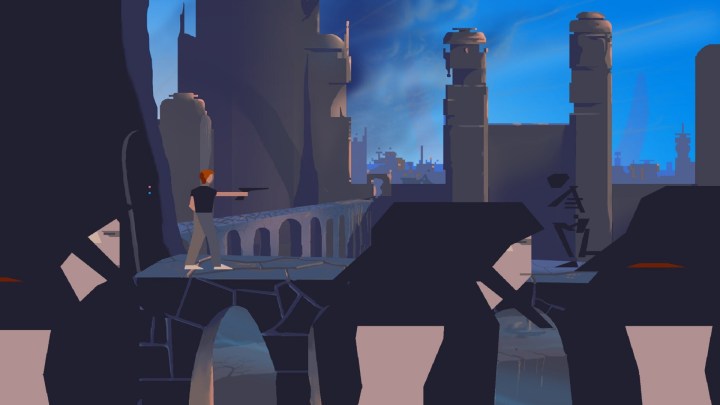
With cinematic platforming, the focus is on providing a platforming experience that is as realistic as possible. Lester isn’t Sonic or Mario – he’s just an average Joe in decent enough shape to get by. Initially, all Lester has going for him is a slow kick, executed by the Y button, but he can gain access to rudimentary weapons and even a laser pistol near the end of the game. Holding Y as the player moves allows him to run – essential for either escaping mobs, or clearing larger gaps by jumping with B. Pressing down allows Lester to duck; he can also pick up items in this way. Pressing up activates elevators, teleporters and gets him to swim upward – which you’ll need to do immediately after getting zapped to the new world. Seriously, this game doesn’t play around.
Wow, Is This Hard!
Trial and error is a big part of games like Another World. Lester can’t survive big falls like other platforming mascots. Heck, make even one false move and the man encounters a cornucopia of pain and suffering that pretty much guarantees a game over. Rather than have a set amount of lives like in traditional platforming games, Another World and other cinematic platforming games give the player an infinite number of them. Upon death, the player restarts at the last checkpoint to try the section again.
Getting to the end required that my jumps be spot-on. In addition, several puzzle elements required precise timing to solve, lest I was stuck and forced to commit suicide to retry the section. It was something that frustrated me slightly, but it was manageable enough for me to finish the game and enjoy it.
Show, Don’t Tell
Another World is a classic example of the old writing adage: “show, don’t tell.” There is very little dialog and lore to explain what the game is about, compared to titles such as Final Fantasy XV or even Ubisoft’s Starlink: Battle for Atlas. Those two aforementioned games, like many others released in the late 2010s, required the player to consume additional content and wrap their heads around the game’s backstory before attempting to understand what the game is all about. Another World doesn’t need to do that. Instead, it presents the narrative by showing the player what it’s about and it does that fantastically, using cinematic techniques like pans and close-ups to tell the story about a man trying to survive in an unfamiliar and unforgiving world with the help of a newfound friend. Little to no backstory required.

“Show, don’t tell” also extends to the atmospheric nature of the game’s audio. Music plays based on visual cues, like in Tomb Raider. Sound effects are quiet, sometimes too quiet, especially when you’re walking down corridors or through caverns. At some point, you hear a squelching sound or suddenly, an alien surprises you and blasts you with its laser before you could even prime your own. What I’m getting at is that the audio direction fits the game well and really helps it become such an isolating and lonely experience.
Wrapping Up
Of all the platformers I’ve played, there’s virtually no other game quite like Another World. Its story of survival may seem similar to games released in the present time, but its setting, its pacing, its foreboding and isolating atmosphere and its surreal nature in of itself is wholly unique and stands up to the test of time. To this very moment, long after I’ve played it, I’m still thinking about Another World’s minimalist story and how its presentation was so fantastically implemented. I’ve rarely encountered a game that’s captured my imagination in the same way that Another World has. Whether you can snag the original cartridge/disk for classic consoles and computers, or pick up the 20th Anniversary Edition for modern consoles and PC’s, I’ve got a good feeling that you’ll come away from it inspired like I have.


Leave a Reply