
Therefore is the name of it called Babel; because the LORD did there confound the language of all the earth: and from thence did the LORD scatter them abroad upon the face of the earth.
– Genesis 11:9, King James Version
The Tower of Babel. A testament to man’s aspirations toward the heavens, a monument to his hubris, and a tale of the scattering of peoples and the breaking of Language itself. It’s a story literally Biblical in age – and also the inspiration for a much more modern tale, 2023’s Chants of Sennaar.
The game is French studio Rundisc’s second release, and is on its surface a simple point-and-click with a twist. True to the tale that helped shape it, Sennaar presents a world centered around a large tower. It opens with a nameless, hooded figure who awakes at the base of the tower. This is the player character, and in proper adventure game fashion, it is their goal to explore and ascend through the tower’s five levels. But there’s a catch, and one that’s probably expected for those familiar with the story of Babel – isolated from each other, the inhabitants of each floor speak a different language. The core of Sennaar, then, is not just your standard point-and-click fare, but also in learning how to interpret the blocks of symbols that serve as the game’s dialogue and signage.
Given my background in linguistics, anything that features language-learning or translation as a puzzle mechanic has a (perhaps expected) way of piquing my interest. There’s a lot I could say about one specific puzzle in Ultima Underworld of that nature, for instance, or about 2019’s Heaven’s Vault, which featured inscription-deciphering mechanics as the core of its gameplay.
It was probably inevitable, then, that Sennaar would come across my radar sooner or later. But how well does it hold up to scrutiny? Patience, O Seeker, for a tower must be built brick by brick, lest it crumble from the lack of a firm foundation. We’ll take this one step at a time, and see whether Sennaar manages to reach new heights, or ends up a crumbled and broken monument.
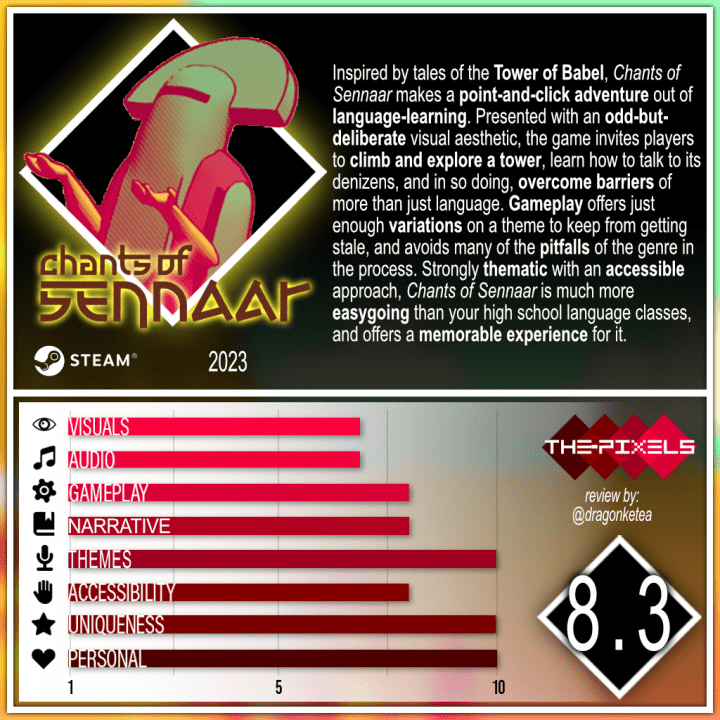
Visuals: 7/10
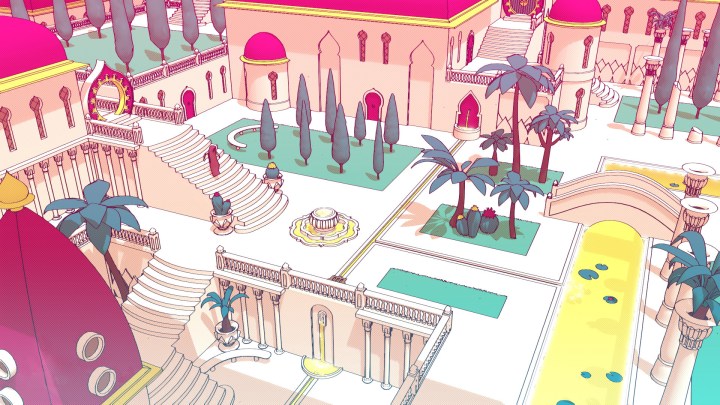
At first glance, Sennaar’s particular art style comes across as a little odd. Not off-puttingly odd, nor poorly-done odd, just in the sense that it may take a little getting used to. Unusual angles and perspectives, sleek, vector-like lines, stark color schemes – “nonstandard, but deliberate” feels like the best phrase to describe it. I’ll admit that I hesitated at giving Sennaar a shot at first due to not being sure its aesthetic would be to my particular liking, but as the game went on, it grew on me. Each of the tower’s five levels feels visually distinct from the others, from palette to design to atmosphere. The sharp, almost glaring golden yellows of the opening section stand in stark contrast to the cold and dark tone of the next level, which in turn gives way to bright, pastoral-like segments, and so on and so forth. Some stylistic choices may seem strange here and there, but this feels purposeful. There’s meant to be a strong degree of isolation between these peoples, after all, and tripping over the occasional facet of design that seems alien only nudges the player closer to that intended sensation.
Audio: 7/10
Sennaar’s soundscape is by and large a simple one. The musical arrangements are typically just a few instruments rather than full orchestrations, and they’re used more for atmospheric backdrop than they are bombastic pieces in their own right. This suits the game just fine, as it’s a more thoughtful sort of game in the first place, and it’s the little stings that prove most effective and memorable. The short little strain that plays once a language has been fully learned, the vocal “ah!” or “oh!” that accompanies an NPC’s speech – these are all nice little embellishments to the moment.
And I’d be remiss if I didn’t mention the piece that plays over the ending sequence – it, too, maintains the overall simplicity of the soundtrack, but given where it plays, it comes across as something I can only describe as “profound.” It’s lovely, and serves as the perfect thematic capstone to the game’s conclusion.
Gameplay: 8/10
If you’re familiar with the genre, then you know what to expect from Sennaar as far as adventure games go. You explore areas, find things to use and puzzles to solve in order to reach new areas to explore, and so on and so forth. There’s nothing particularly groundbreaking here, but there’s nothing done poorly on this front, either. The item-using interface feels a bit clunky, but in the grand scheme of adventure games, it’s a minor annoyance at worst. Other things that can plague the genre with hair-pulling aggravation – strange moon logic, unclear intent, pixel hunts – are largely nonexistent here. Early puzzles instill enough confidence that the game will provide everything needed without being too blatant about solutions, and never throughout the course of the game did I feel like it was withholding things from me. It’s very fair about its puzzles, which is crucial to the enjoyment of an adventure game.
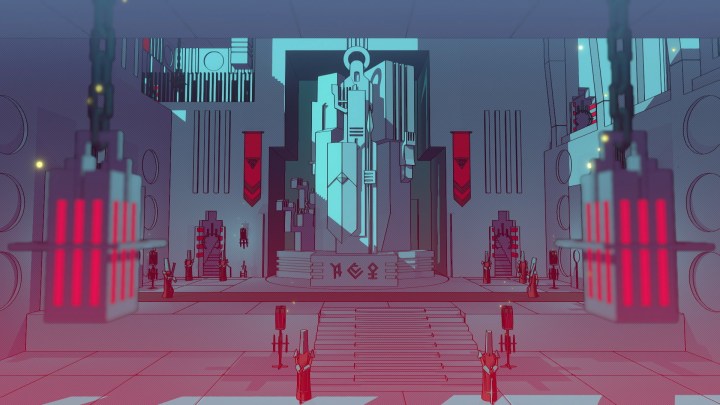
There are several stealth sequences sprinkled throughout as well, and this is where Sennaar feels at its weakest – though by no means poor. They’re clear and well-implemented, with several visual cues as to both when they’re happening and how close you are to being detected. Failing a segment doesn’t result in a drawn-out “game over” sequence, just a quick little silhouette doing a “caught you!”-type animation then plunking you right back in to try again. But they do disrupt the otherwise open, exploratory feel of the rest of the game. Again, this is thematically appropriate in the spaces they’re used, so it’s hardly a bad thing, but it does cause a degree of tension compared to the rest of Sennaar. They serve a purpose, but as Sennaar’s most interesting bits lie elsewhere, it can lead the player to merely want to hurry through them to get to more of “the good stuff.”
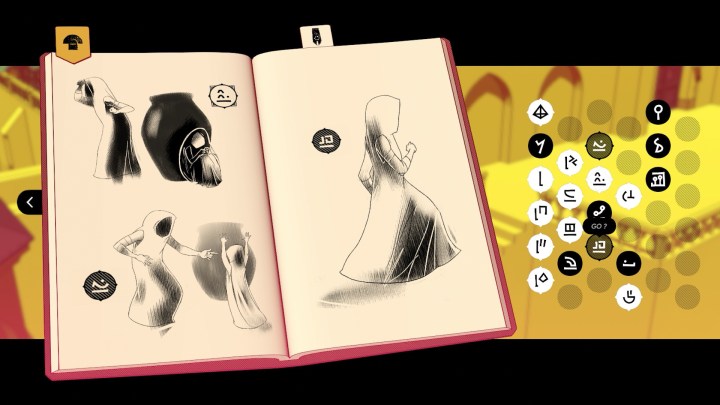
And that “good stuff” is best exemplified by the language-learning. All text is represented by a series of symbols, and it’s up to the player to make sense of what each symbol means in order to understand anything being said. This is handled via an in-game notebook that automatically keeps track of all symbols encountered thus far. At any time, the player may make notes of their own, recording guesses as to what each symbol means. These guesses will then be reflected in dialogue as italicized text with a question mark, in order to indicate this translation hasn’t been confirmed yet. Confirmation comes when a specific set of symbols has been learned, triggering a little puzzle within the notebook, requiring the player to match images to the appropriate symbols.
This probably sounds a little complicated in a pure-word explanation, but the game does a fine job of introducing it and making the process feel intuitive. As well, though there are five languages to learn as the player makes their way through the tower, each introduces a new twist or complication – one language, for instance, will expect the player to figure out how its number system works. It manages to stay fresh throughout, and continually builds on what’s already been learned. Depending on one’s route through their explorations, the game can throw a lot of symbols at you very quickly, which can feel overwhelming (this certainly happened to me on the third floor of the tower), but the game gives plenty of clues via context in order to help make sense of them.
Narrative: 8/10
Much like its soundtrack, Sennaar’s story is a rather simple one, at least on the surface. There’s not much in the way of a backstory or prelude, the game merely drops you right into it – you wake up, you wander around, you find a way up the tower. Up until the last couple floors, there’s little to the story past this. Instead, it’s focused on interacting with the various peoples, learning their ways as well as their language, how they perceive the floors above and below them, gaining a sense of their way of life.
And it’s this sort of narrative where Sennaar is at its strongest – the environmental storytelling. The language-learning aspect of the game already leads a player to pay attention to the details around them: the things characters are doing, the architecture, the art, each of these may provide clues to the meaning behind the symbols everywhere. It encourages the player to not just take in the clues, but consider what it says about the culture of the peoples that inhabit the tower. There is, of course, more to the story than just “climb the tower,” but it’s in gaining that understanding of the cultures involved that really give it meaning. What happens in the story in turn needs a clear picture of the “who” involved in order to land the why of it – and it’s in this aspect that Sennaar truly shines brightest.
Themes: 10/10
The story of the Tower of Babel may be about the breaking of peoples and languages, and the division that follows in its wake, but it doesn’t start there. It can’t – how do you show the weight of the fracture if you don’t take a moment to show what it was like beforehand, when things were whole?
Sennaar, in a sense, inverts the order here, and in so doing, inverts the effect. The original Babel story, after all, is a tragedy – how man’s pride led to rifts in understanding between them. Sennaar, on the other hand, provides a more hopeful outlook, and the seeds of it are scattered all over the game, and indeed baked into its central mechanic. There are hints throughout the tower that things weren’t always so isolated; many broken murals and statuary and such act as a type of Rosetta Stone, providing phrases in multiple languages. It’s part of how the player learns them in the first place, and mastery of them allows the player to provide the same service.
See, there’s one other aspect of Sennaar’s language puzzles that I haven’t mentioned yet. Throughout the tower are several “terminals,” for lack of a better word. These serve as the game’s fast-travel system, helping minimize the back-and-forth between the tower’s levels, but they serve another purpose as well. Some of these terminals also allow for communication between the levels, and it’s here that the player can act as a proper translator. These puzzles require one to understand enough of both languages involved to relay the messages between the two people involved, remembering the unique quirks of syntax and semantics to turn one string of symbols into another that means the same thing.
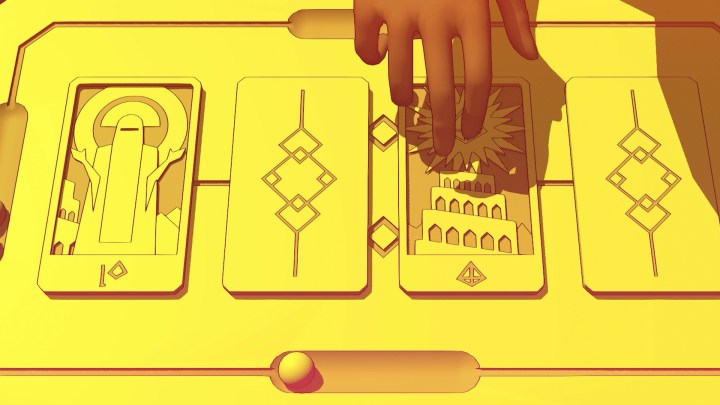
At first glance, there’s something to be said here about overcoming language barriers. But given the nature of these conversations, and the setup around them, it becomes much more than that. In exploring the tower, it’s easy to get a sense of what each culture thinks of the others, from a distance. The levels above are thought of as nobility, or gurus, or otherwise high-and-mighty figures, out of reach but to be respected, honored, or venerated. Those on the floors below, on the other hand, are clearly seen as silly, misguided, or lowly.
The conversations the terminal puzzles facilitate, however, allow the player – who needs to have spent sufficient time around both peoples to learn their language, enough to recognize maybe neither group has the full picture of the other – to provide a much more human sort of exchange: one side laments a problem they’re having, the other offers a potential solution. Complete the exchange and, as the game will put it, something will change within the tower. Slowly but surely the towers’ residents become less isolated from each other, and Sennaar reveals itself as more than just a tale about overcoming language barriers. It’s about overcoming other sorts of barriers too, demonstrating that the differences in our ways of life can serve to complement, rather than divide, and maybe – just maybe – the things we consider most important may not be so different after all, just perhaps seen from different angles.
Idealistic? Perhaps. But it’s lovely all the same. Sennaar takes Babel’s tragic resolution and gives it an optimistic epilogue, using the core of its gameplay to deliver it. It’s poignant, it’s thought-provoking, and it’s woven into the very fabric of the game, from its design to its mechanics. What could make a better case for a strongly thematic game?
Accessibility: 8/10
Given that this is a game about language-learning, I’m sure there are some out there remembering high school foreign language classes and recoiling from the very thought. If that’s you, you can take a breath. Sennaar does its best to make itself as approachable as it can, and largely succeeds. The game makes sure it gives you the tools and context to figure out what symbols mean what, and takes care to make sure this context is always available to you. There’s no worry here about missing out on a vital clue, let alone permanently. Interactables can be highlighted with a hotkey, and “cutscenes,” such as they are, can be replayed via clicking an object near where it took place. It feels natural and intuitive – more like a logic puzzle than it does trying to remember how to properly conjugate a foreign verb. As mentioned before, depending on how you choose to explore, the game can throw many, many symbols at you before you’ve got a way to confirm them, which can feel overwhelming, but one step at a time. There’s no need to brute-force it – all the info will be out there to find. And though each floor of the tower comes with a new vocabulary to learn, it continuously builds on what’s been learned before, adding just that little extra bit of complexity or new twist on top of it – just the way a good puzzle game should.
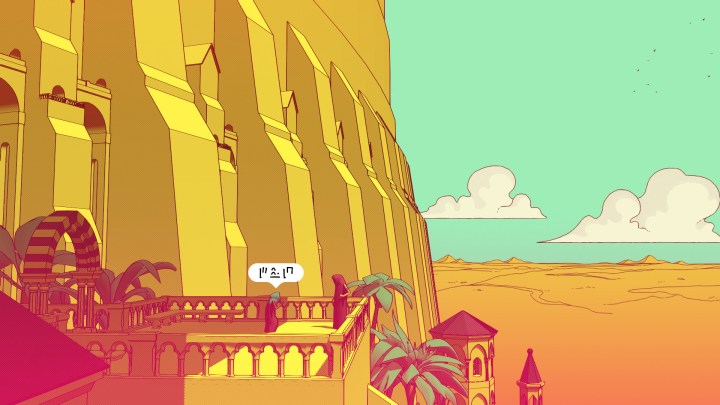
It’s also worth noting Sennaar has some robust localization options, as befitting a game revolving around translation, so it’s even accessible in multiple languages.
Uniqueness: 9/10
Sennaar is hardly the first attempt at gamifying translation and learning a new language, but it’s probably the most dynamic one I’ve seen yet. Here, the languages aren’t merely inscriptions from a bygone era – they’re actively used, and part of unraveling their purpose is to observe what people are doing when they speak. It’s living language here, not just static text on the screen. Language is a thing intricately tied to cultures and societies and peoples, and Sennaar, more than any other game I’ve seen involving language-related puzzles, understands this. So too does one need to pay attention to more than just vocabulary: grammar and syntax play a role in gleaning meaning from the game’s symbols as well. There’s an acknowledgement of complexity here that I really appreciate, and it approaches it from an angle that makes it distinct.
Personal: 9/10
Let’s not beat around the burning bush here: I’ve gone on record calling this my personal Game of the Year for 2023. And this isn’t just because I enjoyed the premise, the gameplay, or its handling of its central themes – though I do, a great deal! No, I call it such because this is a game that lingers, in all the best ways. I called it my favorite of 2023 because, in short, I can’t stop thinking about it. How its core mechanics could be developed further, the impact its final scenes had, how it struck a balance in maintaining momentum without overstaying its welcome. I’ve used the word “simple” a lot in this critique, and that’s because Sennaar is a simple game at its heart – and it speaks all the stronger for it. It isn’t too long, but it leaves me with so much to reflect upon.
And for all of the words I’ve spent discussing it, maybe that’s the real magic of Sennaar. It’s the reminder that sometimes, the best way to understand is to stop talking and take in what’s around you.
Because in the end, that’s what’s going to stay with you the most.


Leave a Reply