
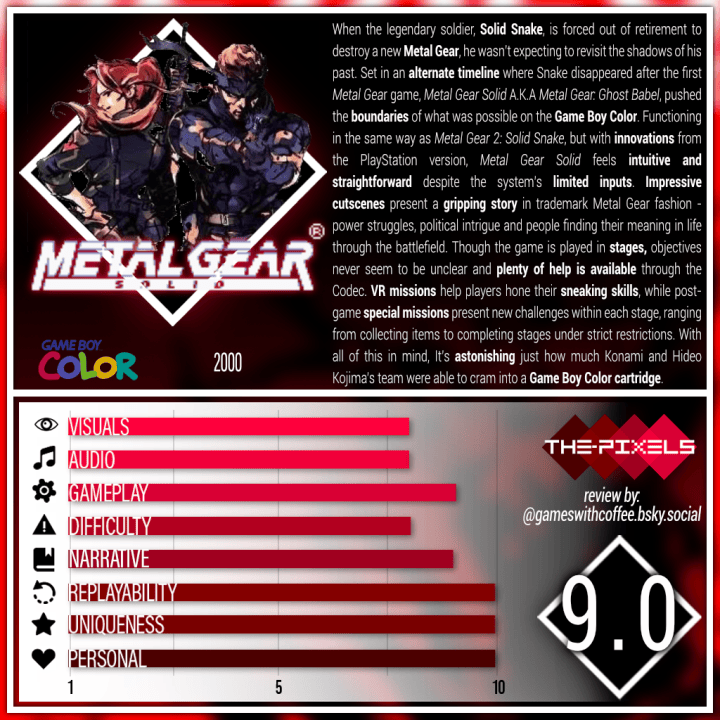
“Life is worth living, even if it hurts you.” ~ Solid Snake, Metal Gear Solid (GBC)
1998 was a big year for handheld consoles. After almost ten years and numerous competitors doing it well before them, Nintendo finally released a Game Boy with a colour screen. From upgrading older titles like The Legend of Zelda: Link’s Awakening, to titles developed solely for the Game Boy Color, like Pokémon Crystal, the Game Boy Color ushered in a new era of games that pushed the boundaries of what was possible on an 8-bit handheld system.
One such boundary-pusher was Metal Gear Solid, released on the handheld system two years after the breakthrough PlayStation title of the same name. Though they share a name, the two games are vastly different from one another. Also known by the moniker Metal Gear: Ghost Babel, Metal Gear Solid takes place in an alternate timeline, where Solid Snake, legendary soldier and former member of FOXHOUND, retired from active service after the events of the original Metal Gear. In 2002, seven years after Operation Intrude N313, Colonel Roy Campbell recalled Snake to active duty to sort out a mess only he can handle.
The Mission
The game’s prologue presents, in impressive-looking cutscenes, a rebel separatist force from the fictional South African country of Gindra. They manage to steal a top-secret Metal Gear prototype developed by the U.S. Army, along with the researchers developing the prototype and a nuclear payload, and plan to use it to end the civil war ravaging the country. Snake’s mission is simple; infiltrate the fortress Galuade – built from the remains of Outer Heaven – rescue the kidnapped researchers and destroy Metal Gear before its construction is complete.
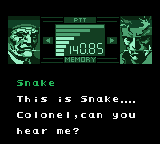
On the surface, it seems a straightforward task. However, this wouldn’t be a Metal Gear game without there being a mission within the mission – a hallmark of the series. As Snake progresses through the story, it’s revealed that this whole exercise is nothing more than a power struggle between the U.S. National Security Advisor Steve Gardner and the U.S. Army General John Parker. Both were vying to take control of something even more deadly than Metal Gear: Project Babel. Without going into too many spoilers, Metal Gear Solid goes into the narrative of a global superpower using the guises of civil war and nuclear catastrophe as a way to ensure continental supremacy, citizens and innocents be damned. It’s incredibly intriguing, especially when you consider that the game’s story was tailored enough to attract the Game Boy’s typically younger demographic while still retaining its mature and hard-boiled image.
Operating Your Operative
Metal Gear Solid functions similarly to Metal Gear 2: Solid Snake for the MSX, but adds elements from its PlayStation namesake. It’s played from a top-down perspective, with Snake being able to move around in eight directions. Pressing START allows Snake to crouch; moving in this position allows Snake to crawl, which is very useful for getting underneath trucks, infiltrating vents and picking up mines and whatnot. Like in Metal Gear Solid for the PSX, Snake can press against walls by holding the appropriate direction button. He can then either sidle against the wall or knock on it by pressing the A button. Snake’s radar can be found at the top right part of the screen. While it looks simple, it accurately shows enemy locations and maps out your surroundings. Just like in the PlayStation version, the radar gets jammed easily.
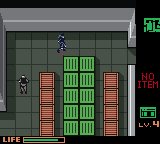
The A and B buttons control Snake’s items and weapons. Pressing SELECT opens up a item menu, where players can equip items and weapons by pressing Up/Down or Left/Right on the D-Pad respectively. Pressing START after pressing SELECT opens up the Codec, where Snake can contact his allies to save his game, review objectives, get advice on weapons and enemies and learn more about the cast of characters in the game.
Snake has access to a variety of weapons that are similar to those found in the PlayStation version; from a silenced pistol all the way to the Nikita remote missiles. Absent from this list are the Stinger missiles and PSG-1 sniper rifle, for understandable reasons. Items include keycards, rations, IR and night vision goggles and, of course, cardboard boxes – the latter of which really do come in handy at times.
Stealthy as a Snake
Metal Gear Solid is broken down into stages. In each stage, Snake must complete a set of objectives, from infiltrating the fortress to destroying a power plant and even simply navigating the base in complete darkness. Players must do so both as stealthily as possible and with the finite resources available.
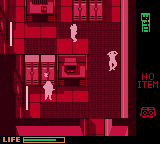
Guards and cameras detect you from line of sight, as opposed to the conical field of vision seen in the PlayStation version. As long as you’re not directly in front of them, you can slip past unnoticed. Distracting guards with loud noises, like knocking on a wall for instance, can disrupt a guard’s movements, pulling them away from their predetermined patrol path and giving players opportunities to advance. And, of course, knocking them out with a few punches gives you ample time to move about and plan your next move.
What really surprised me was just how intuitive the controls were. As complicated as the story of Metal Gear was, I appreciated that the controls and gameplay were so straightforward. The fact that you can hone your skills in over 180 VR training missions on top of the main game is also pretty awesome.
Enter the Black Chamber
Standing in Snake’s way are the members of Black Chamber – the survivors of a black ops unit formed after FOXHOUND got too famous in the aftermath of the Outer Heaven incident. Their role in this story is that they’re out for revenge on both FOXHOUND and the person who gave their position away and left them for dead during a mission that went south. Fights are presented as intense, pattern-filled affairs that require some strategy to pull off, yet they’re not super difficult to complete.
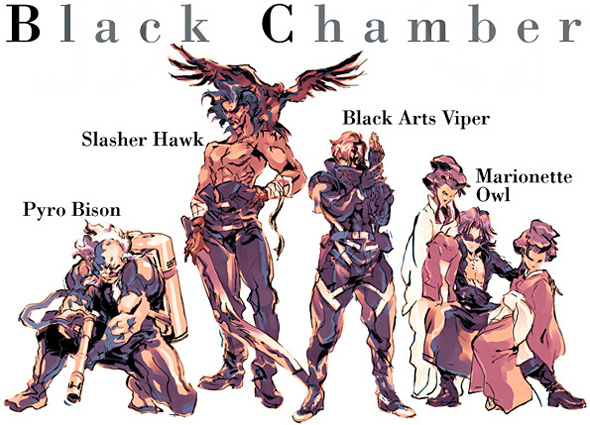
Players can expect to encounter the likes of Pyro Bison, a flame throwing pyromaniac; Marionette Owl, an operative that fights in complete darkness using marionettes; Slasher Hawk, a boomerang-user with a pet hawk; and the group’s leader, Black Arts Viper, who is considered to be one of the best mercenaries in the world. Players can also contact the team via Codec to get advice and tips on beating the bosses. With the right tools (grenades) and proper patter recognition, players can expect to get through the fights without too much trouble.
Other bosses to tackle include an assault helicopter and the titular Metal Gear, piloted by the rebel leader, General Augustine Eguabon. The Metal Gear fight is a pretty fun one with multiple phases to tackle, and it works because of how the game handles scrolling, unlike its predecessors Metal Gear and Metal Gear 2: Solid Snake.
The Sounds of the Jungle
Audio plays a major role in Metal Gear Solid, not just in the soundtrack, but also in audio direction. As mentioned above, any noises you make can warrant the attention of the guards. While it’s useful in some scenarios, in most cases, the goal is to get through an area both unseen and unheard. (E/N: Again trimmed a bit here.) From squeaky floor tiles to unsuppressed shots ringing out and even birds being startled, players have to be mindful of their surroundings unless the strategy demands creating a diversion or two.
The soundtrack, meanwhile, really fits the tone of the game. The music while sneaking through the fortress is very downbeat and brings to mind the need to slow down and plan things through. On the flip side, boss music is tense and high energy, signifying the need to kill or be killed. In addition, a few classic Metal Gear tunes from the first and second games make an appearance – the track that plays when you’re discovered is the exact same one from the very first game.
An Ammo Crate’s Worth of Content
Besides the VR missions, players can replay stages after beating the game to get better rankings. Ranks are determined by time elapsed, enemies killed, times discovered and rations used.
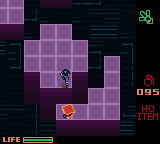
There is also a special mission mode accessible after beating the game that gives players new objectives, three for each stage. Some missions have you collect FOXHOUND patches, while others put time, distance or weapon restrictions on you. These extra missions are a lot of fun and are definitely a challenge to complete.
Wrap Up
With its 40th birthday looming in the distance (and mine too, considering we share birthdays), the Metal Gear series has had some interesting and impressive titles. Still, it’s astonishing just how much Konami and Hideo Kojima’s team were able to cram into a Game Boy Color cartridge. From the set pieces to the cutscenes and the gameplay, Metal Gear Solid definitely holds up well to the test of time. It’s an excellent game for both Metal Gear fans and fans of the stealth genre in general.


Leave a comment