
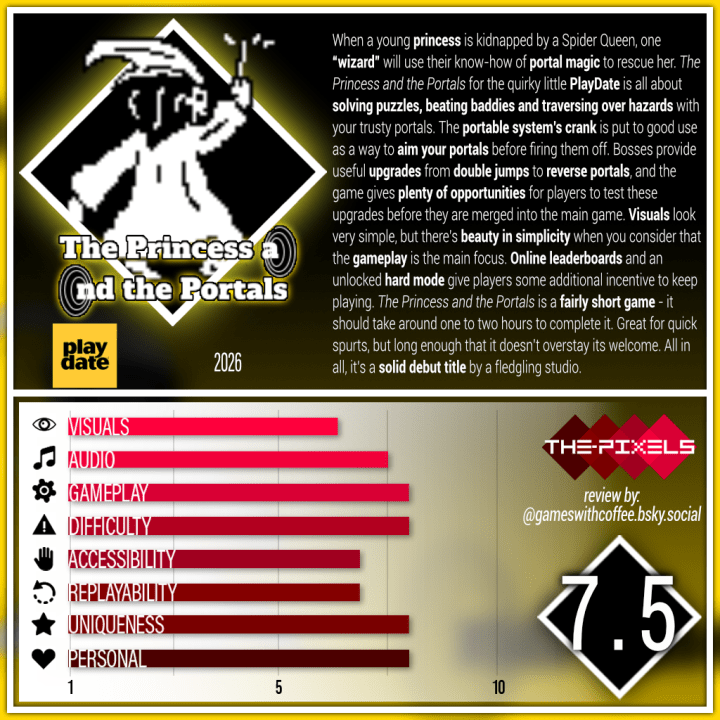
The princess has been kidnapped, and it is your job to save her as an intrepid wizard who apparently only knows one spell – how to make portals! ~ Overview, The Princess and the Portals
What happens when you take a Game Boy, cut down a third of its space, add a crank, an accelerometer, give it internet capabilities and paint it yellow? You get the PlayDate built by Panic – a tiny, handheld device that’s a throwback to the Game Boy era, but with a smooth LCD screen and an audio chip powerful enough to deliver some modern sound. While it’s a low-tech device, it’s capable of delivering some solid, bite-sized indie games that take full advantage of the additional sensors, inputs and network capabilities. Case in point is today’s game; The Princess and The Portals – our first review for the system.
Seems Familiar?
For those familiar with the game Portal, this might seem like a retro derivative of the landmark Valve title; however, that’s where the similarities end. You play as a wizard who knows how to make portals and make them very well. Your task is to rescue Princess Penny from the clutches of the evil Spider Queen. Along the way, you’ll solve puzzles and take on five bosses with your trusty portals as your only means of attack.
Portal Wizarding 101
You control the wizard by pressing left or right with the D-Pad. He jumps when you press up. Once you gain the ability from the first boss, you can create Reverse Portals by holding down. Speaking of portals, the A and B buttons respectively create them. You can use these portals to traverse the environment, defeat enemies, activate pressure plates and redirect projectiles. Any object shot into an A portal will continue in the same direction out of the B portal. With Reverse Portals, when a projectile enters an A portal, it shoots out of the B portal in the opposite direction. Portals are also bi-directional; you can enter from A to B or B to A with no problems.
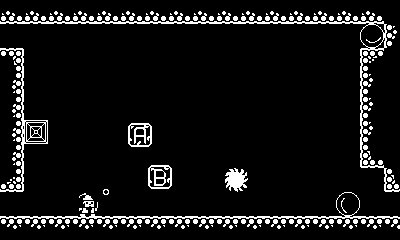
If you hit an enemy, a projectile or touch a trap, you are sent right back to the beginning of the room. Interestingly enough, you can use deaths to your advantage by setting up a portal in a safe zone before you die and then creating another portal when you respawn to bypass obstacles.
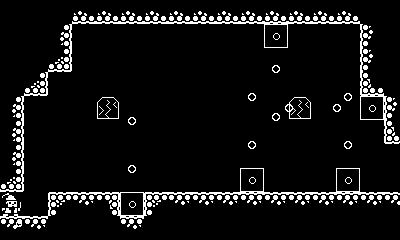
But how do you aim the portals? That’s the ingenious part; you use the crank! A little circular reticule spins around the wizard as you turn the crank. Pressing A or B launches a portal in the direction where the reticule is aiming at. At first, your portals can only be launched at a short range – about a quarter of the screen. Once you receive a range upgrade after defeating the third boss, you can create portals that cross about three quarters of the screen length. The crank is also used to open up gates, which is pretty fun to do.
Fiendish Fiends and Fiendishly Good Rewards
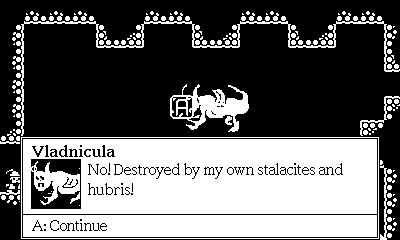
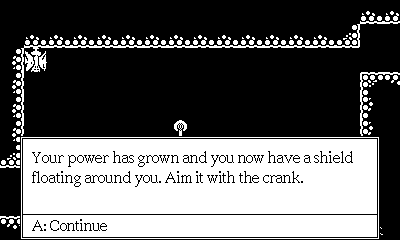
On the subject of bosses, each boss grants you a new ability once defeated. Defeating them mainly involves redirecting projectiles back to them using regular or Reverse Portals. The second boss grants you a shield to block projectiles, represented by a solid circle on your portal reticule. Turning the crank adjusts the shield. The fourth boss grants a double jump and right near the final boss (along with a sweet little plot twist), you gain the ability to hover. The levels after each boss/event gives players an opportunity to test out each new ability before incorporating it into the overall game.
Art and Audio
Visually speaking, the artwork for The Princess and the Portals is very simple; however, there is beauty in simplicity. The white tilework contrasts fairly well against the dark screen and there’s quite a bit of variety with it. The game also uses animated sprites in the negative spaces to keep things interesting – fitting for a small, Game Boy-esque game.
There are only a few songs in the game, but the main theme is definitely an earworm. It’s currently stuck in my head. There is a bit of a disconnect between the music and the spritework. I was expecting more of a chiptune sound, but it’s still catchy nonetheless.
Length, Challenge and Issues
At 65 one-room levels, The Princess and the Portals is a fairly short game that can be finished within an hour and a half to two hours. That’s long enough to kill some time, but short enough that it doesn’t overstay its welcome. Furthermore, the game hits a fairly sweet spot when it comes to difficulty. The game is not too tough to the point of frustration, but not too easy that it feels like a cakewalk. Beating the game unlocks a hard mode, and there are leaderboards for fastest completion time, lowest number of deaths and fewest portals made.
Controls could be a bit tighter while falling. I was trying at one point to avoid spikes on the walls by nudging the wizard to one side, but I overcompensated and ended up clipping a spike, causing me to return to the beginning of the room. I also had an instance on the third boss where I had to restart the level because it was no longer shooting any projectiles at me; this was due to me accidentally creating a portal level to the exit and the projectile striking and getting stuck on the door.
Wrap Up
Full disclosure: I’m friends with the developer from Pwned and Operated Studios LLC. I’ve watched him build this game in one of the Discord servers I hang around in, and I was happy to reach out to request a review copy. But just because we’re friends does not stop me from giving an honest and thoughtful critique of his work. Still, for a debut game, The Princess and the Portals is a solidly fun one. And the things that need improvement can be carried onto the sequel, 2 Princess 2 Portals.
We’d like to thank Pwned and Operated Studios LLC for providing us a review copy and instructions on how to play the game without a PlayDate.


Leave a Reply