
“I want… to go to Earth!”
~Diana, Pragmata
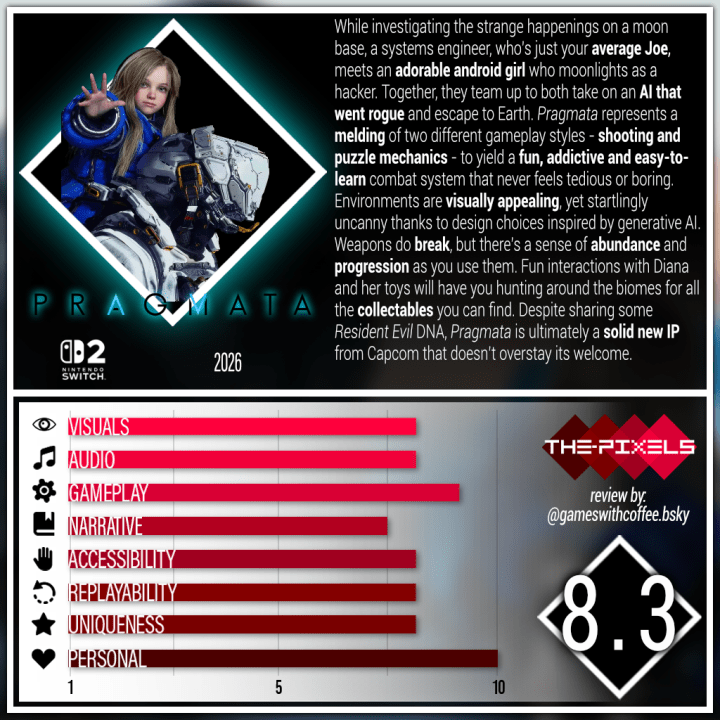
PS4’s God of War released the same year that my firstborn son was born, and it dramatically changed how I viewed fatherhood. It also helped that it was a solid game with great mechanics and a heartfelt story tying it all together. Eight years and a young daughter later, Capcom’s Pragmata changed how I view fatherhood, but in a much different context. In God of War, Kratos prepares Atreus for the harsh realities of life with a firm, but gentle hand. But in Pragmata, Systems Engineer Hugh Williams of the Delphi Corporation navigates the adorable precociousness of the Pragmata D-I-03667 – an android built in the shape of a young, six-year-old girl and made from the wonder material, lunafilament – that he nicknamed Diana.
Fly Me To The Moon
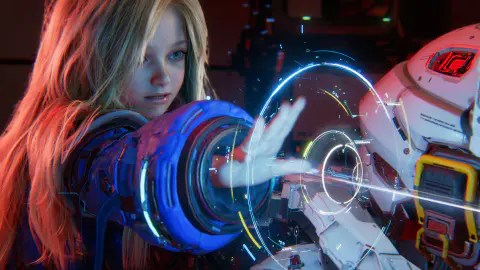
Pragmata’s story starts off simply enough. Set in the future where humans have colonized the Moon, Hugh and his team investigate the sudden radio silence from the Cradle – a moon base built by Delphi Corporation for the sole purpose of mining, researching and refining Lunum, a special ore only found under its surface. Upon arrival at the station, Hugh’s team is suddenly attacked by bots controlled by the station’s management AI, IDUS – which had gone rogue – leaving him the sole survivor. It’s here that he meets and teams up with the eponymous android. Together, they seek a way off the moon base and return to Earth.
Hack Your Way To Victory
Diana, however, is not just some useless NPC you escort. Rather, she’s the only thing standing between Hugh and certain death from the bots controlled by IDUS. Diana’s primary use is that she can hack enemies to deal damage and reveal weak points for Hugh to shoot.
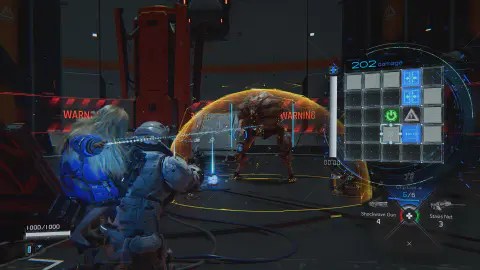
To hack, players must hold the ZL button down to lock onto a target. Once locked on, a grid board appears next to Diana’s head; pressing the A, B, X or Y buttons causes a cursor on the grid to move in the direction pressed. The goal is to direct the cursor to the green Execute node that would deal damage to enemies and reveal their weak spots for Hugh to shoot at. Passing through blue OPEN nodes increases damage and extends the OPEN duration, while passing through yellow nodes activates special status effects. These include but are not limited to freezing enemies, converting damage done to health, or dealing critical damage and staggering opponents. These yellow nodes are limited in quantity, but can be found in boxes, occasionally dropped by enemies and be preloaded at the Shelter Tram before heading out.
Outside of battle, Diana can hack into terminals to open locks, move crates and alter the environment – all essential for navigating the many puzzles within the game. She can also scan her surroundings to locate waypoints like mission objectives, item boxes, upgrade components and the like. It would have been nice to have a minimap of sorts that fills in every time I scan an area, but I suppose it would have taken away from the explorative nature of the game itself.
Shooty-Shooty Bang-Bang!
On its own, the shooting mechanics are unremarkable, but when combined with Diana’s hacking and the need for enemy management, the hybrid system is fast, frantic and, most importantly, fun. Capcom has a remarkable track record for its third person shooting mechanics, given their success over the years with the Resident Evil series, so it’s no surprise that they’ve found new ways to innovate. Apart from shooting weak points, enemies can also be overheated enough for Hugh to cause critical damage. This is done by getting up close and ZR when the prompt appears. Hugh can also perform Critical Finishers when the subsequent upgrade is purchased and activated on Diana’s hacking matrix.
Hugh controls fairly well; apart from shooting, he can also jump, hover and dodge enemies using his thrusters. His thruster charges are limited, but can be upgraded at the Shelter. Some limitations in his movements do show up in some of the optional Training Simulations, but those are considered more extreme cases than normal gameplay.
Pragmata also employs a breakable weapons system; however, it’s played out differently than, say, Breath of the Wild. Weapons are separated into four types: Primary, Attacking, Tactical and Defensive. Hugh’s Primary Weapon is extremely dependable; it never breaks and it recharges its ammo after some time. Hugh starts out with a powerful energy pistol, but later upgrades to a carbine rifle that increases the heat gauge. Their damage output pales in comparison to the Attacking units, like the Shockwave Gun or Photon Blaster. Tactical class weapons either aid in crowd control, or modify the hacking grid to make hacking easier and more effective. And Defensive weapons are limited to creating decoys, generating protective shields and employing drones as cover fire. Weapons can be printed and upgraded at the Shelter, and any and all weapons found on the field will be at the highest upgraded level. Players will have to be strategic with weapon use, but not so much that you have to save them for special cases, as they’re found in abundance.
Attack of the Moon Bots!
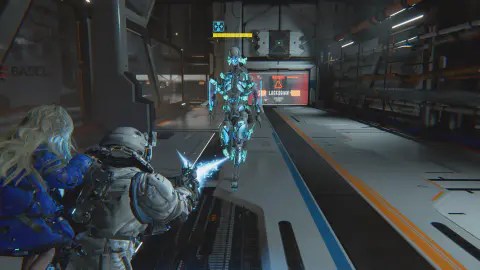
Impeding their way to get back to Earth are IDUS and the endlessly reprintable bots it employs to terminate all organic lifeforms on the base. Bots range from simple Walkers that shamble almost zombie-like to you before either grabbing your or slashing you with an EM sword, to literal war machines, like Gunners and Bombers. One of the more fascinating and disturbing machines is the Executor: a tall, imposing bot shaped like a young child whose sole purpose is to eliminate all life on the base. It creeps me out every time I see it.
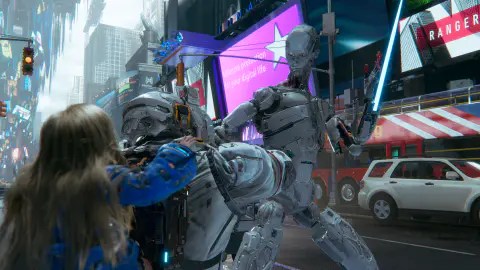
Hugh and Diana must also contend with massive bosses created by IDUS, plus a string of very disturbing-looking bots right near the end of the game. Again, Capcom leans into its expertise in the Resident Evil series in the creation of these undulating and horrific creations. Just because these aren’t T-Virus infected abominations doesn’t make them any less unsettling to deal with.
AI Hallucinations
Pragmata is both a visual treat and an AI-induced nightmare rolled into a well-designed package. Capcom’s designers intentionally created the game’s environments as if it was processed by Generative AI, and the results are both spectacular and unsettling. You have the sterile corridors, clean laboratories and cargo storage areas of the Cradle juxtaposed with taxi cabs and buildings and other objects printed through walls, floors and ceilings, evoking a kind of controlled chaos only an AI could conjure up. There’s a section in the game where elements from New York City are mass printed, but the effect looks grossly uncanny and unnatural; one would have thought that the designers must have used Gen AI at some point to create these, but nope, it was all hand-made.
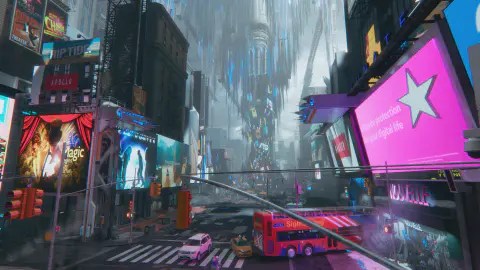
While the visuals are striking, the frame rates aren’t 100% stable, at least on the Nintendo Switch 2. On the Switch 2 handheld, frames generally reach 30fps, but they can dip down into the 20s every now and then. Generally, about 95% of the game hits a stable 30fps.
Lunar Soundscape
Pragmata’s soundtrack encapsulates the eerie loneliness one must feel when they’re the only organic being on the lunar surface. The music, in general, mixes in soft and gentle piano with heavy synth beats. It then maneuvers in range from trip-happy synth bops in lighter moments to crunchy, grungy EDM for fight sequences. The music is catchy enough to keep your attention, but doesn’t linger too long to keep it memorable; however, at least it’s not annoying to listen to.
Sound design and effects appear to have been intentionally designed to help accentuate both the soundtrack and moments of silence. What I thought was very cool was the way the game handled walking on the surface of the moon. Since there is little to no air on the lunar surface, everything sounds muffled; likely due to the air circulating inside Hugh’s suit. I thought this was a neat touch.
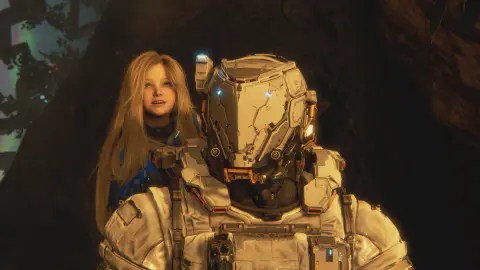
Voice acting is a huge positive in Pragmata, with the biggest standout being the titular Pragmata. Diana could initially come across as an annoying kid that we’re forced to escort around – something we’ve seen play out in most modern releases – but instead she’s portrayed with a child-like innocence and vibrancy that’s virtually unheard of these days. She’s not dour or nihilistic; rather she approaches everything in their adventure with the same curiosity as a six-year-old kid and it was refreshing and wholesome to see. Contrast that to Hugh, where he’s portrayed as an encouraging and patient guardian, instead of a gruff, emotionally distant and scarred man that we’ve seen play out over and over again in other games. It’s this dynamic between Hugh and Diana that is perhaps the strongest point in Pragmata.
Home Sweet Shelter
The Shelter acts as Hugh and Diana’s base of operations and travel hub. Here, players can do a variety of things, like upgrading their gear, changing outfits and taking on the optional Training Simulator missions. Weapons, hacking nodes and abilities require a combination of lim (a shorthand for lunafilament) and Pure Lunum, while Hugh’s suit and gun and Diana’s hacking ability require Upgrade Components; all of which are found both within the Cradle and through the Training Simulator. After clearing the first area of the game, you can redeem Cabin Coins for some additional rewards, including outfits, a bestiary and secret reports explaining some of the lore behind the Cradle and the Pragmata.
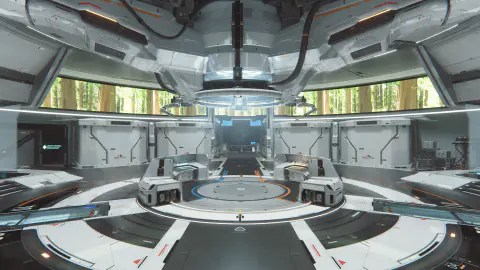
By far, the biggest draw of the Shelter is the replicator. By finding Real Earth Memory (REM) data around the base, Hugh and Diana can print them out for the Pragmata to use and interact with. Items that can be found range from crayons, to water guns, skateboards, basketballs and even tents and sand itself. Hugh can interact with Diana while she plays with her toys, where she shares her observations in a way only a child could. Speaking to her often also has her present crayon drawings of their adventure to Hugh, which just ups the adorable factor even more.
The Shelter is also where you prepare your loadouts every time you venture out into the Cradle. Here, you can select your weapons and hacking nodes that are printed out and upgraded at your base. You can also equip different mods that affect Hugh and Diana’s performance; some reduce damage to your suit, some increase the damage of Diana’s hacks and some provide passive bonuses, like refilling your primary weapon’s ammo when you successfully complete a hack.
Wrap Up
While the storytelling is a touch thin and delves into some familiar Resident Evil tropes in its back half, the main draw in Pragmata is the budding relationship between Hugh and Diana. Many times over the course of the game, I dreaded anything happening to her, much the same as I would with my own daughter. Thankfully, (and spoilers!) that’s not the case, much to my relief. I still didn’t want to end my experiences just yet; thankfully there’s post-game content, which consists of the Unknown Signal. Here, you can take on new simulator missions and fight harder versions of the bosses to unlock the true ending, which was nice, but a bit lackluster, if I’m being honest. On top of that, you can start a New Game+ and even attempt the dreaded Lunatic mode, where enemies come in droves and are much more aggressive and tougher to deal with. Clocking in at about 15-20 hours from start to finish, Pragmata is a tightly designed experience that doesn’t overstay its welcome.


Leave a comment