
“Blood makes you related. Love and loyalty makes you family.”
–Katie Reus
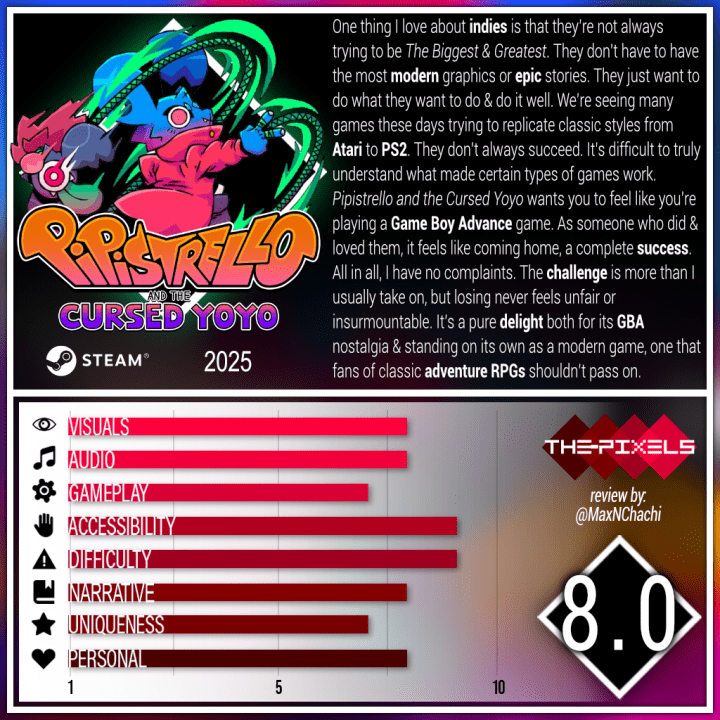
One thing I love about indies is that they are not always trying to be The Biggest And Greatest. They do not need the most modern graphics or epic stories. They just want to do what they want to do and do it well. We are seeing many games today trying to replicate classic styles from Atari to PS2. They do not always succeed. It is difficult to truly understand what made certain types of games work. Pipistrello and the Cursed Yoyo wants you to feel like you are playing a Game Boy Advance game. As someone who did and loved them, it feels like coming home and is a complete success.
You are Pippit Pipistrello, a young moocher aiming to be a yoyo champion but far from achieving it. To get by day to day, he depends on his doting aunt’s wealth. She is an electricity tycoon and a bit unethical in her business practices. She has earned many enemies, and they just so happen to show up the same day Pippit does. He wants her money, and they want her life. In an act of foolish bravery, Pippit manages to save a portion of her soul in his yoyo. Now she wants the rest of herself back, and only you can help.
Style and Gameplay
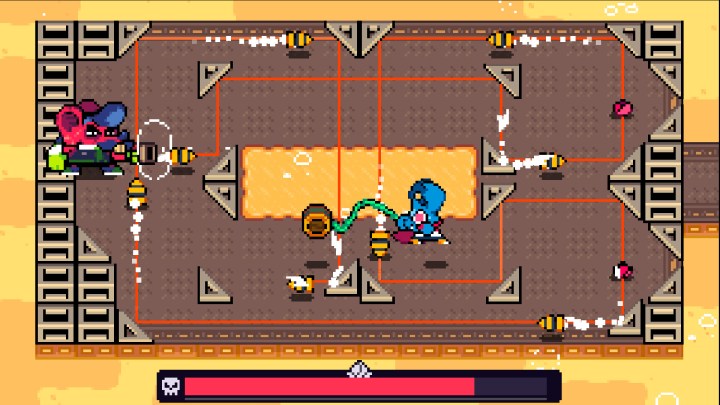
Pipistrello and the Cursed Yoyo plays like a top-down Zelda, but with the added benefit of slick yoyo tricks. As you learn more, your ability to navigate the world expands, allowing you to explore more avenues in the city. Instead of a fantasy land of forests and deserts, you are in the big city. The city streets are busy and full of people to talk to and cars to run you over. How is your Frogger game? I do not mean you are literally playing Frogger, but you will get hit by a lot of cars.
Visually and auditorily, Pipistrello and the Cursed Yoyo is, for all intents and purposes, a GBA game. From the start, the music immediately transports me to younger days, booting up Pokémon Emerald and that array of “slightly better than chiptune” music. The graphics draw you in further with cartoonish, eccentric characters and bright colors. It is a GBA delight from the intro screen.
Challenge
Do not let the cute and colorful aesthetic fool you. Pipistrello and the Cursed Yoyo is no cakewalk. This is not a game that does anything in half measures, including the health bar. Unlike some of its predecessors, you do not lose half a heart (or rose, in Pippit’s case). You start with three health, and you get three hits. There is a decent amount of invincibility time after getting hit, so it is not unfair if, for example, you get hit and fall into water. You are also briefly invincible while jumping, but landing is a different story.
That said, death is not the huge detriment it often is. For one, there is no “lives” system and no “Game Over.” On death, if you choose, you can return to your family safe house and get a full heal, but you start back where you last checked in. If you are feeling bold, you can instead restart the room you were killed in. You lose 10% of your money on hand, but you get as many chances as you want at the challenge that killed you.
Accessibility
If fights keep feeling too hard, there is a very player-friendly difficulty option in the menu. Need more healing roses to drop? You can do that. Want more badge points? Done. Whatever you feel you need to make the game more enjoyable despite the inherent difficulty, it is there for you. Pipistrello and the Cursed Yoyo is one game that you should not let difficulty stop you from trying.
Finding Your Way
Special credit goes to whoever designed the maps. A common problem in exploration games is maps that only show you where you have been. A good map lets you leave marks on places to return to. A great map does that for you. Pipistrello is a great game. Whether it is an incomplete side-room or a pickup left unclaimed, the map will show you what you have not done. It makes it easy to tell when you have missed a hidden side path, skipped a sidequest, or forgotten where a quest delivery was. It is honestly one of the best maps I have encountered in an exploration game, and it deserves major props.
You can also teleport back to the safe house whenever you like at no cost or punishment. You just have to walk back to where you were. With as much as there is to do at the safe house, this is incredibly useful. Along the way to revive your aunt, you will find lost cousins who want to help. From giving you upgrades (at a cost) to making and improving badges, you will find yourself heading back often to tweak your build. Luckily, there are entrances all over the city.
Final Thoughts
All in all, I have no complaints about Pipistrello and the Cursed Yoyo. The challenge is more than I usually take on, but losing never feels unfair or insurmountable. It is a pure delight both for its GBA nostalgia and for standing on its own as a modern game. Fans of classic adventure RPGs should not pass on this one.
Special thanks to PM Studios for Pocket Trap supplying us with a copy of Pipistrello and the Cursed Yoyo for this critique.

 The-Pixels
Leave a reply to Kalas Cancel reply