
“The first rule of being a ninja is, ‘Do no harm.’ Unless you mean to do harm. Then do lots of harm.”
-Master Splinter, TMNT 2012
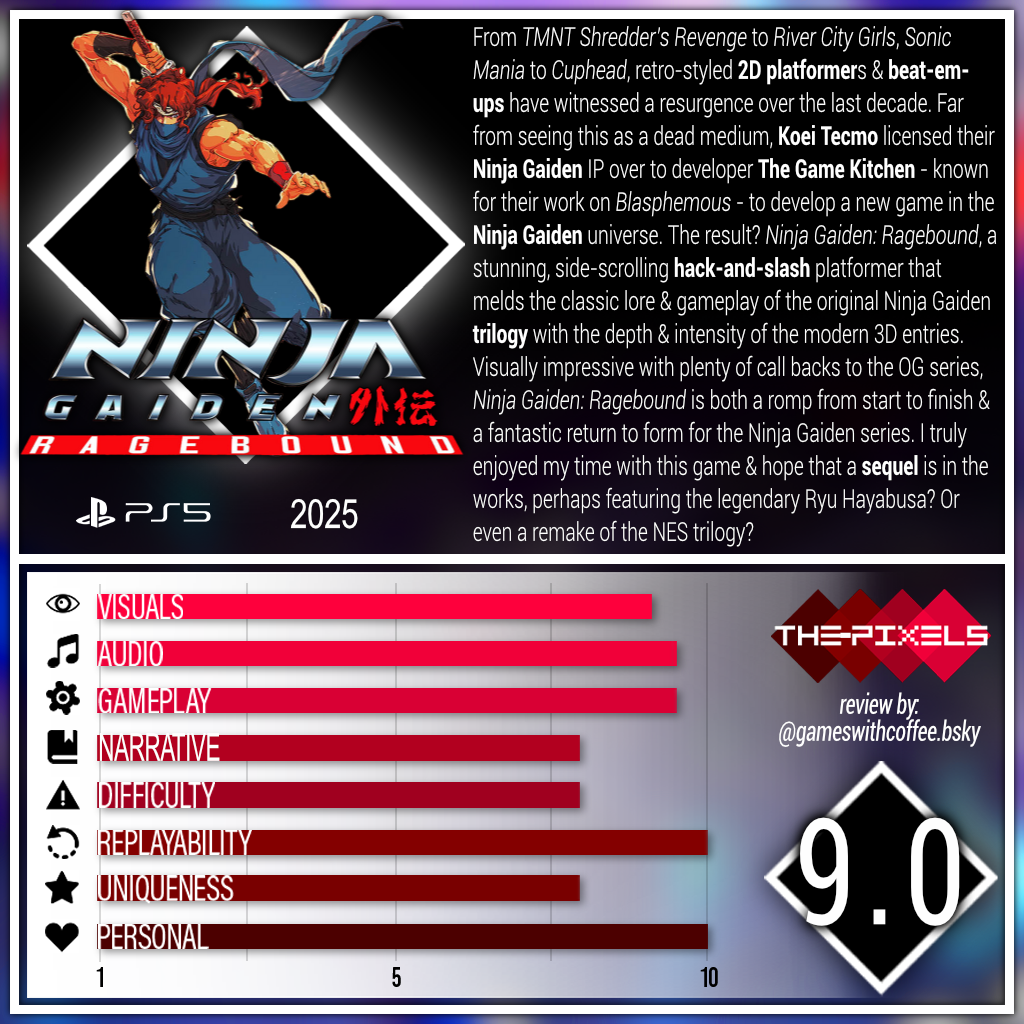
From Teenage Mutant Ninja Turtles: Shredder’s Revenge to River City Girls, Sonic Mania toCuphead, retro-styled 2D platformers and beat-em-ups have seen a resurgence over the last decade. Far from seeing this as a dead medium, Koei Tecmo licensed their Ninja Gaiden IP to developer The Game Kitchen, known for their work on Blasphemous, to develop a new game in the Ninja Gaiden universe. The result is Ninja Gaiden: Ragebound, a stunning, side-scrolling hack-and-slash platformer that melds the classic lore and gameplay of the original Ninja Gaiden trilogy with the depth and intensity of the modern 3D entries.
New Tricks for Veteran Ninjas
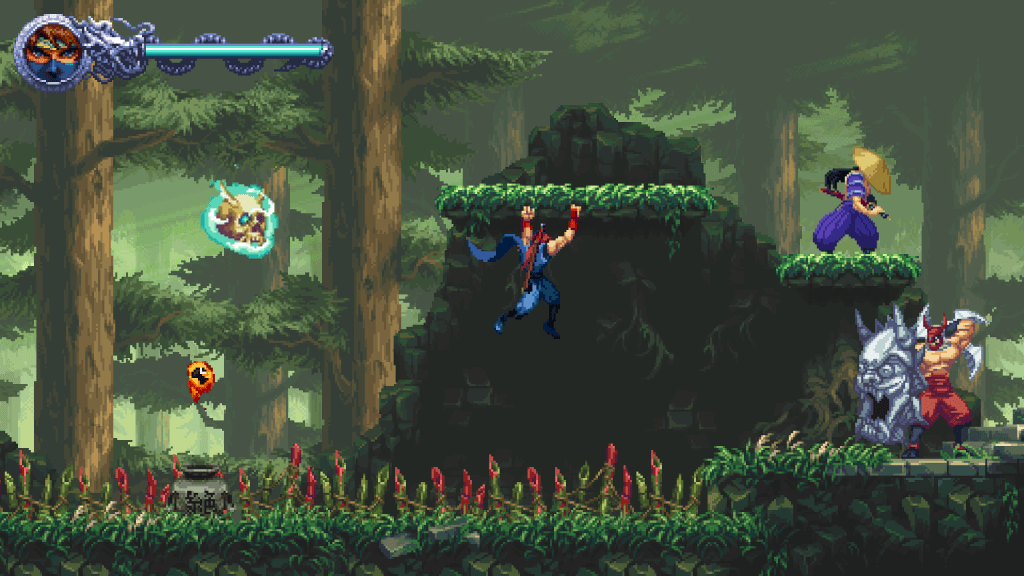
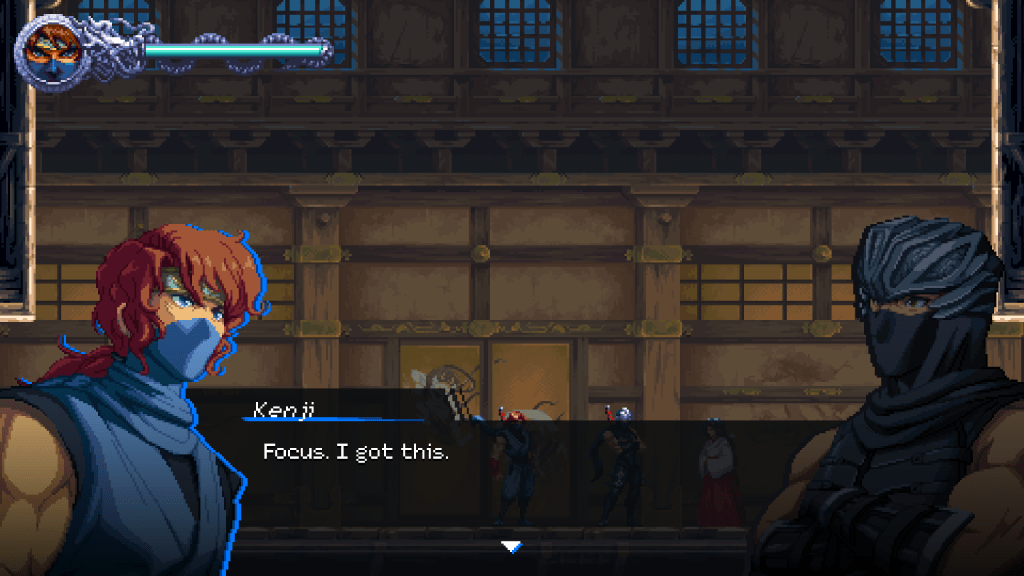
Ninja Gaiden: Ragebound takes the focus away from Ryu Hayabusa, scion of the legendary Hayabusa ninja clan, and moves it to newcomer Kenji Mozu. After a brief prologue depicting the events leading up to the beginning of Ninja Gaiden, players take control of Kenji in the midst of a training session with Ryu. Here, the player is guided through the basic mechanics of Ragebound, including dodging, deflecting projectiles, and thrusting. Players are also introduced to two crucial techniques: the Guillotine Boost and Hypercharge.
By pressing either L1 or X while in the air, the Guillotine Boost causes Kenji to spin while enveloping him in an aura. Hitting enemies, projectiles, and even certain hazards and breakable objects in this state grants him a small, mid-air boost. Despite dealing half as much damage as a normal attack, it is essential for crossing chasms, reaching higher ground, and avoiding attacks that cannot otherwise be avoided through dodging.
Kenji gains a Hypercharge whenever he kills an enemy surrounded by a blue aura. A Hypercharged attack allows Kenji to either insta-kill any normal enemy or stun and deal heavy damage to bosses. Hypercharge is exceptionally useful against both shielded enemies and opponents that can handle a lot of punishment. Like the Guillotine Boost, Hypercharges can be chained as long as the next enemy has an aura around it. Kenji can also manually charge a Hypercharge at the cost of his health by holding Square.
The Dragon and The Spider
Taking place concurrently with Ninja Gaiden, Kenji sets off to defend the Hayabusa Clan village in Ryu’s absence after it is beset by demons. Following them back to the Ku no Tani, a gate within Mt. Fuji that keeps the Demon Lord at bay, he is ambushed and left for dead in the Demon Realm. It is here that he meets Kumori, a high-ranking kunoichi within the Black Spider Clan, trapped alongside him after a proposed deal with or betrayal against the Demon Lord went sideways.
While Kenji is skilled in close-range combat with the katana, Kumori specializes in ranged attacks using kunai. She utilizes the same moves and techniques as Kenji, including the Guillotine Boost and Hypercharge. However, she can fire kunai in four directions. I personally wished she could throw kunai in all eight directions instead of four, but I realize that would have made the game easier.
Fu-Sion-HA!
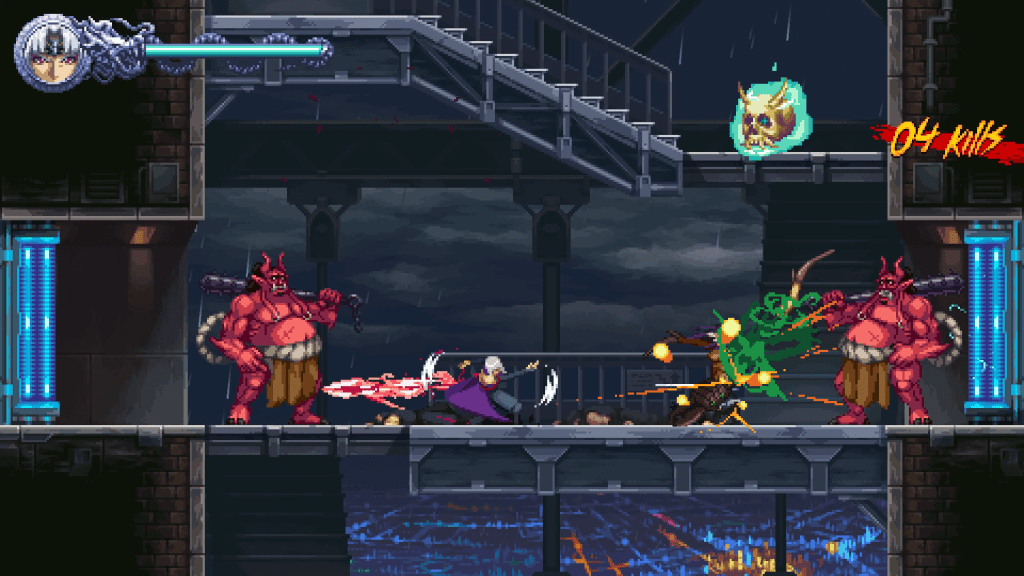
After Kumori fuses with Kenji, players can access her skills by pressing either Circle or Triangle. Pressing Circle throws a kunai, while pressing Triangle activates a Spider Weapon, similar to one of the many subweapons from the Castlevania series or the Ninpo arts in Ninja Gaiden. Each kunai or Spider Weapon consumes a portion of the Ki Bar, which is located just underneath the health bar. Kenji and Kumori start off with a Kama, a sickle thrown in a high arc, but soon gain access to new weapons like homing fans, grenades, and chakrams. Each successive attack on an enemy refills a portion of the bar, while hitting a red orb refills about a quarter of the bar. It may sound like a pittance in writing, but with all of the slicing and dicing you are doing, that bar fills up quicker than you think.
Pressing both Circle and Triangle together unleashes a Ragebound Art. Used in pinch situations, these Ragebound Arts can turn the tide of any encounter in your favor. They are best saved for boss fights. In fact, there is even a challenge to defeat a boss using a Ragebound Art. Killing enemies refills the Rage Orbs on your health bar. Aside from the Kunai Burst, players gain access to two other Arts, one of which is highly recommended if you are not using Assist Mode.
An Untold Tale Within The Ninja Gaiden Saga
Ninja Gaiden: Ragebound lives up to its “Gaiden” translation as a side story to the Ninja Gaiden series on the NES. The game explores what happened to the Hayabusa clan in Japan while Ryu was traipsing around the United States and South America. There are multiple references and callbacks to the first Ninja Gaiden, including mysterious women, duplicitous members of the CIA, and powerful demons who wish to wreak havoc on the world.
Game Kitchen could have stopped there, but they went full steam into body horror, a signature of theirs, which was a great choice. The use of demon energy to create freakish supersoldiers coupled with the CIA agent’s zealotry really increases the tension in the story.
While the whole “demons attacking to free their lord from the Demon Realm” scenario is not new, what makes the game interesting is the dynamic between Kenji and Kumori. I am a sucker for the “enemies to friends” trope. Kenji is morally rigid, hot-tempered, and impulsive, while the laissez-faire Kumori is equal parts bloodthirsty and snarky. The two are complete opposites, not just in clan but in personality. Yet, their fusion, coupled with their shared goals, forces them to walk in each other’s shoes and learn what makes them tick, often to insightful and hilarious results. Despite the short journey, the two go from begrudging allies to trusted comrades, which makes each of the three endings all the more bittersweet.
Visuals and Audio no Jutsu
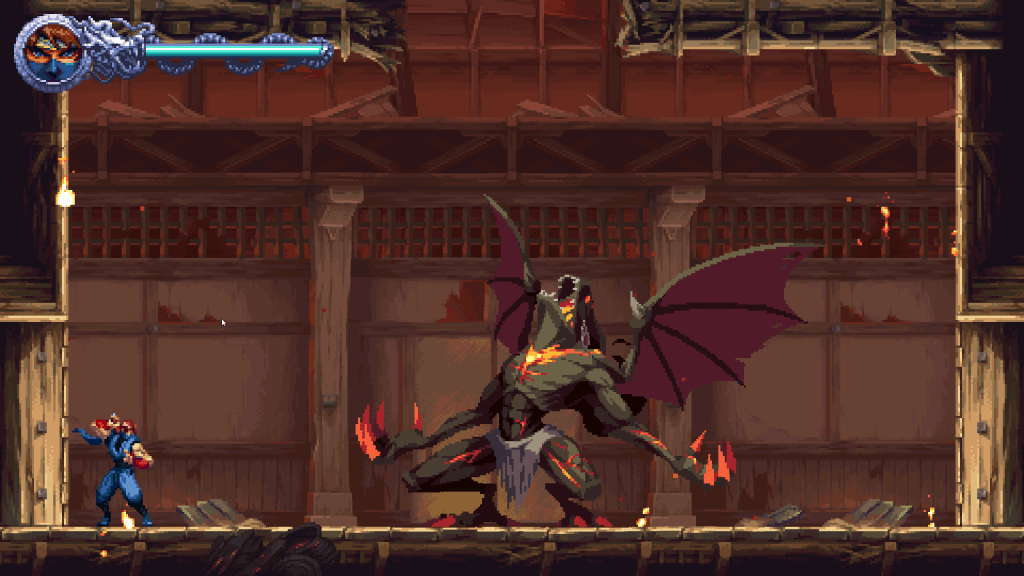
The high-stakes, high-octane story is complemented by some of the best pixel art and animations I have seen in recent years. Each level, from backdrops to movements to enemy variations, is a visual treat filled with layers of detail. Animations are fluid and the framerate maintains a consistent 60fps, even when things get very busy on screen. I witnessed no stutters or lag during my entire playthrough.
I did see a few glitches and bugs, including one hilarious moment in stage 2-2 where, after a series of unintentional mishaps that I cannot replicate, I found myself driving backwards. Despite these minor bugs, the game is still visually polished.
The excellent, high-energy soundtrack featuring a mix of original and remixed music complements the gorgeous visuals. Fans of the original Ninja Gaiden will recognize iconic tracks like “Requiem” and “Unbreakable Determination” (also known as “The Amazing Ryu”). Sergio de Prado, the composer of Ragebound and sound designer from Blasphemous 2, nailed the Ninja Gaiden feel with original tracks such as “On the Way to the Moonlight Duel” and “Find Your Inner Peace.”
Ninja Mastery
Your performance in Ninja Gaiden: Ragebound is measured based on six factors: time, number of kills, maximum combo, challenges completed, and collectibles obtained. The faster you complete a level with more kills and a high chain of enemies defeated, the better your ranking. Each factor is weighted differently. For instance, if you take a long time in a level, you can still achieve a decent rank based on the other factors.
Each level has three challenges to complete. These challenges vary from defeating a certain type of enemy, to avoiding pits, to killing enemies with certain attacks. Along with challenges, Crystal Skulls, Golden Scarabs, and Secret Scrolls are strewn around each level, counting toward your final ranking. While the Crystal Skulls are nice collectibles, the Golden Scarabs and Secret Scrolls serve a dual purpose. The former can be used as currency to purchase equipable talismans and new Spider Weapons or Ragebound Arts, while the latter unlocks Secret Ops missions, which are harder variants of certain stages. Collecting all the Crystal Skulls and Golden Scarabs in both Normal and Hard modes unlocks new costumes for Kenji and Kumori.
Need An Assist?
Finally, I will touch on Assist Mode. While Ninja Gaiden is notorious for its difficulty, Game Kitchen added Assist Mode to make the game more accessible. Players can adjust various aspects, such as game speed, the amount of damage taken, or the Guillotine Boost radius. It is recommended to beat the game first without Assist Mode before enabling it; the game even displays a dialogue box suggesting this.
Assist Mode works in both Normal and Hard modes. Setting incoming damage to zero nullifies any enemy attack. The only way to lose health is by manually charging a Hypercharge. This does not mean you cannot fail no-hit or pitfall challenges. Assist Mode is also great for planning speed runs or no-hit runs. Want to find the optimal route through a level without worrying about your health? Assist Mode has you covered.
Final Thoughts
Visually stunning, with plenty of callbacks to the original series, Ninja Gaiden: Ragebound is both a romp from start to finish and a fantastic return to form for the Ninja Gaiden series. I truly enjoyed my time with this game and hope that a sequel is in the works, perhaps featuring the legendary Ryu Hayabusa himself or even a remake of the original trilogy. Either way, Game Kitchen presents compelling evidence that they are the perfect stewards for this franchise.
Thank you to Dotemu and the Game Kitchen for supplying us with a copy of Ninja Gaiden: Ragebound for this critique.


 The-Pixels
Leave a reply to SnapperTrx Cancel reply