
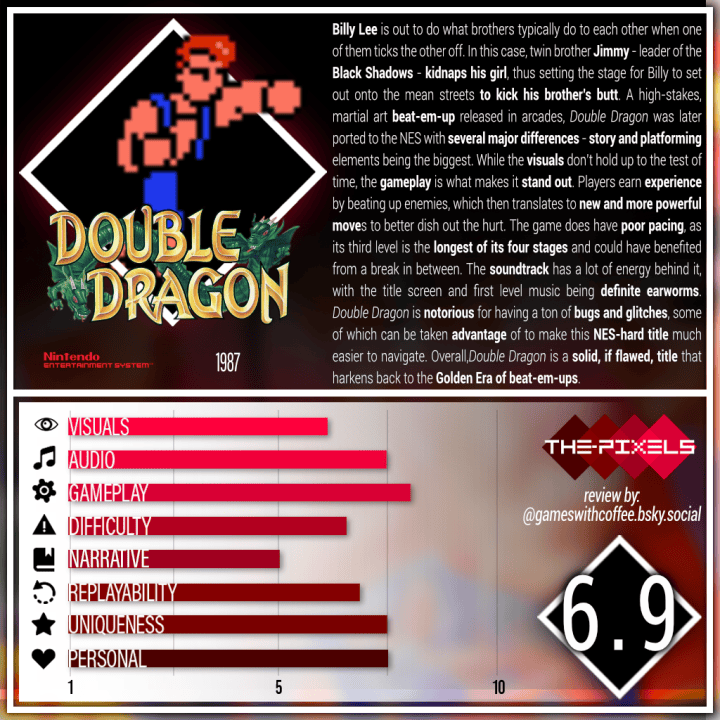
“You’ll never have to stand in line to play Double Dragon again!”
– Double Dragon US Box Art
First released in arcades back in 1987, Double Dragon became an instant hit both in Japan and North America, and ushered in a “Golden Era” of beat-em’ ups released in the late 80s and early 90s. With the game’s success in the arcades, Technos ported the game to other consoles; the most well-known version being the NES port. The developer made many changes to the game’s story, which was a direct result of their inexperience with Nintendo’s hardware. Notably, they made Billy the sole protagonist of the game, while his brother, Jimmy, became the main antagonist and leader of the Black Shadows.
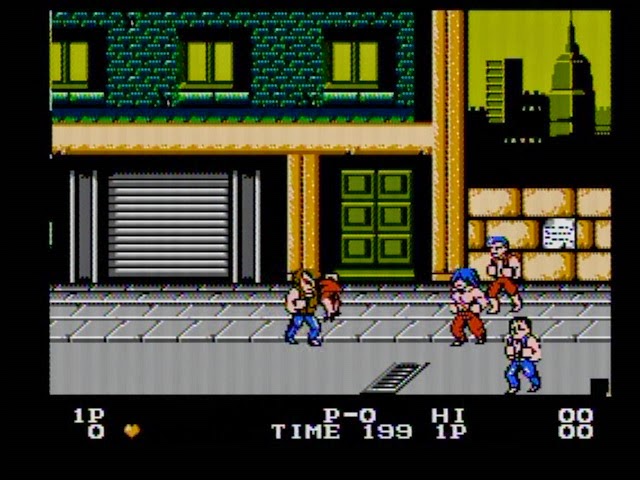
In the NES version, Jimmy kidnaps Billy’s girlfriend, Marian. Spurred on by her capture, Billy braves the Black Shadows to catch up to his brother and beat him up for his ill deeds. This version implements a level-up system, with more powerful techniques being unlocked as you progress through the game. Additionally, stages have been redesigned from the arcade version to emphasize platforming elements.
Art of the Dragon
Controls are very straightforward, as they are in a vast majority of NES games. D-Pad controls movement. You punch with A and kick with B. You jump by pressing both buttons together. Double Dragon implements a level up system, where you earn new moves as you beat up enemies. Each move grants a certain number of experience points when they connect and players need to collect 1000 points to unlock the next move.
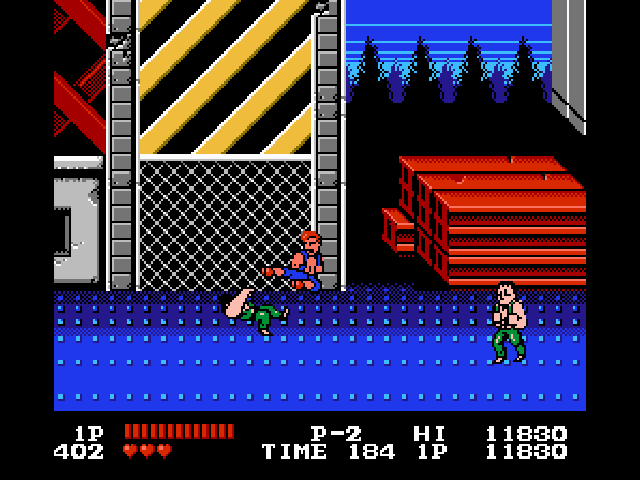
At level 2, you gain a combo finisher. You gain the ever-versatile Jump Kick and the Hair Grab moves at levels 3 and 4 respectively. Level 5 grants the Pin Punch, performed by pressing Down+A while an enemy is on the ground. Billy mounts the enemy and pummels the heck out of them until they’re unconscious. The Elbow Punch is an incredibly devastating move and is useful against stronger enemies like Abobo and Chintai. You unlock it after reaching level 6. The final move is the Cyclone Kick, an upgraded finisher learned at Level 7.
Know Thy Enemy
Billy has six different types of enemies to deal with: Williams, Lindas, Rowpers and Chintai are your standard fare, although you won’t see Chintai’s regularly until Mission 3. Williams carries knives and dynamite, while Lindas can use whips. Billy can take advantage of these weapons for his use. Rowpers are like Williams, but can take a bit more of a beating. Finally, Chintai uses punches and kicks and is a fairly strong enemy to contend with.
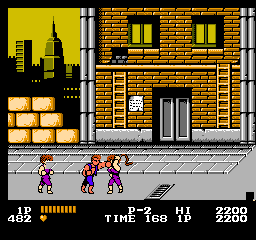
The last two enemy varieties are the most difficult – Abobo and Willie. You fight Abobo most often as a mini-boss and he’s one tough customer to deal with. It’s best to keep your distance while using kicks, jump kicks and, later on, the elbow punch to defeat him. Willie, meanwhile, is a cheater that uses a machine gun to fight. He’s found at the very last stage of the game, right before you face off against Jimmy Lee. The best way to fight him is to get above or below his line of sight before striking.
Visuals and Pacing
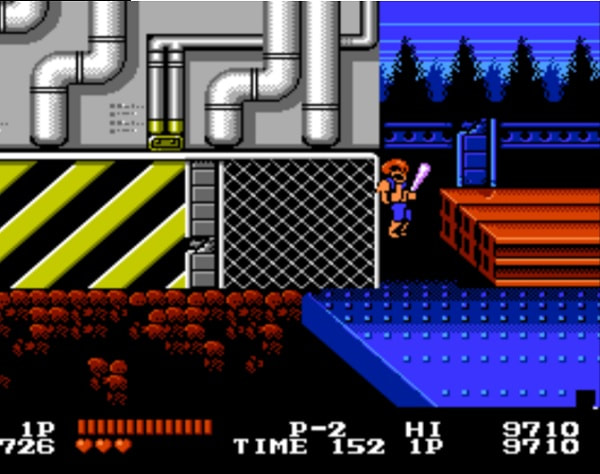
Double Dragon doesn’t hold up well in the visual department, but the gameplay more than makes up for it. Levels consist of a mix of back alleys, industrial areas, caverns and martial arts strongholds. Technos employed palette swapping on the six enemy types, which made it look like there were more enemies than listed. Palette swapping also had the effect of knowing how powerful foes are, giving players a visual cue of a strong vs. weak opponent. As mentioned above, platforming elements were added to the home console release. Billy has to leap onto platforms to progress, or avoid high-damaging moving stones as seen in Mission 4.
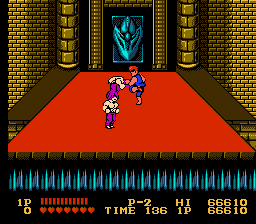
In terms of pacing, Double Dragon is a weird game due to its short length. The game is only four stages long, but the third stage itself could have been broken in half. It’s incredibly long compared to the other three stages, and it’s usually the point where most players encounter the highest amount of difficulty.
Audio
One of the best things about Double Dragon is the soundtrack. It’s got a ton of energy behind it, fitting for a beat-em-up. The title theme and the Mission 1 level theme are extremely memorable, so much that they’re practically earworms. Effects-wise, every strike, thud and landing in Double Dragon sounds heavy, almost impactful. It’s something you want to hear when you’re playing a beat-em-up.
Bugs and Glitches Aplenty
While Double Dragon is a classic home console experience, it’s not without its faults. Due to Technos aforementioned inexperience with Nintendo hardware, the game could only generate two enemies on screen at any time. There were also multiple bugs and glitches; some of which were game-breaking. One example is the invisible Williams glitch in Mission 2, where you can potentially max your experience gauge by beating up an invisible enemy after drawing a Williams to a certain point near the beginning of the level. In that very same mission, you can also bypass the boss by climbing down the ladder as soon as he shows up, leading to instant victory. And one can’t forget about the Mission 4 weapon glitch, where, with good timing, you can potentially get a weapon for each wave of enemies before facing the final boss.
Wrapping Up
Double Dragon was my very first beat-em’ up game. A friend of mine growing up introduced this to me when I was about 8 or 9 and it became one of a bunch of childhood titles that I was never able to beat. It took me about 30 years and the Nintendo Switch Online service to get around to it, but I felt a huge sense of accomplishment when I landed the final blow. Then again, I had a little help from save states and rewinds to get to that point. Regardless, a win is a win.
Overall, it was fun to return to Double Dragon after all these years. It’s still as hard as I remembered it, harder even than its sequel, if I’m being honest. Double Dragon, despite its flaws and glitches, is a title that I’ll come back to from time to time, even if it’s purely for nostalgic purposes.


Leave a comment