
“There is magic in the old and magic in the new; the trick is to successfully combine the two.”
-A.D. Posey
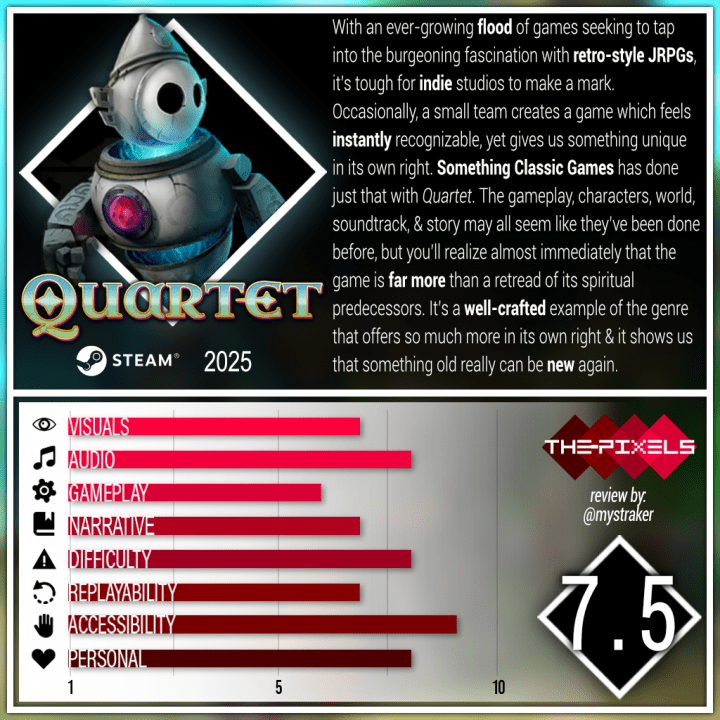
Retro-style JRPGs are so hot right now. Whether it’s a massive publisher like Square Enix or a tiny indie development team, there is a profound allure to a role-playing game that feels like an old friend. Today, there are many different interpretations of this nostalgic formula: HD-2D experiences like Octopath Traveler, remastered versions of classics like the Final Fantasy Pixel Remaster collection, updated titles such as the current Dragon Quest remakes, and entirely new games like Chained Echoes, Sea of Stars, and Unicorn Overlord carving out places of their own. The selection of modern JRPGs is vast, and with new entries arriving quickly, it’s becoming more challenging for smaller development teams to stand out. Fortunately, the imagination and skill of some independent studios are enough to flourish, and Something Classic Games has managed just that with their recent release, Quartet.
Narrative
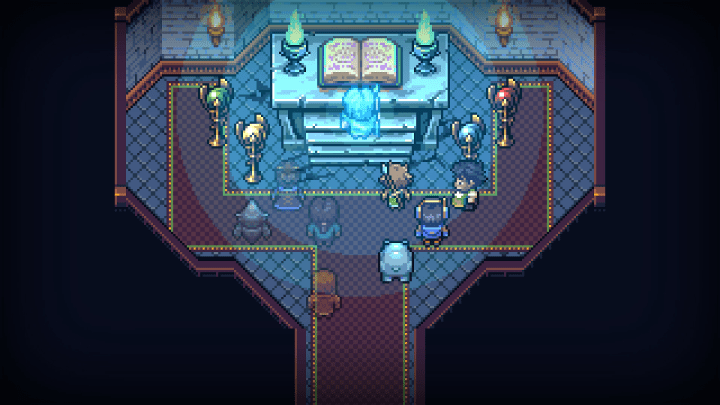
When you begin a new game in Quartet, you are prompted to choose one of four characters and their “origin” storylines. You can play them in any order you wish, and your choice has no lasting impact on later story events. This design is similar to Octopath Traveler. The four main protagonists are Nikolai, a sergeant in the army of the authoritarian Auslen regime; Ben, a chef in the bustling city of Akos; Cordelia, a graduate of a magical academy; and Alexandra, a young woman running a small shop to support her ailing mother. Each character’s prologue serves as an excellent introduction to the in-game world, its diversity, and how these individuals’ lives are suddenly uprooted as events unfold.
Your party will eventually expand to eight members, filled by characters met during the prologues who become allies as the story progresses. These companions are no less unique than the origin characters—you’ll even recruit a robot and a hippopotamus—and each one plays an important role in the larger narrative.
The story focuses on the immense power of magic and its influence across societies. Some live in harmony with it, some reject it, others use it responsibly, and still others seek to dominate others through it. While this premise might sound familiar, Quartet’s treatment of magic’s history and its personal impact on each character drives the emotional core of the story. Without spoiling key details, the party’s ultimate goal evolves beyond defeating a single antagonist to shaping the future of the world itself. Will they learn from the mistakes of their ancestors, whose secrets are revealed along the journey, or will they fly too close to the sun as their predecessors did?
The narrative is both fantastical and relatable, addressing universal truths about human nature and society. Through its characters and plot, Quartet explores themes such as politics, morality, the responsible use of power, the impact of kindness, and even the horror of genocide. The story moves briskly, offers compelling twists, and keeps you invested throughout.
Visuals
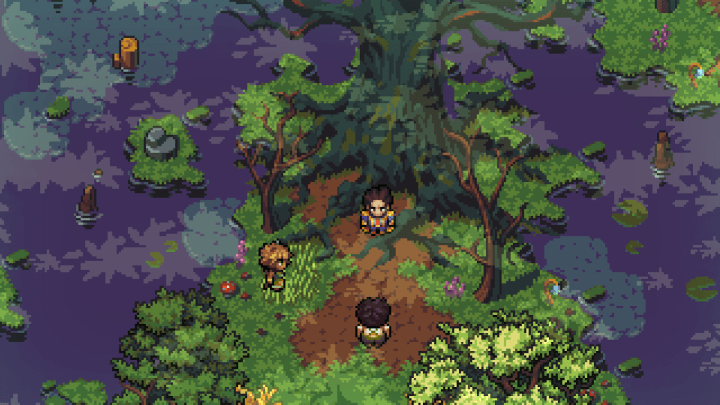
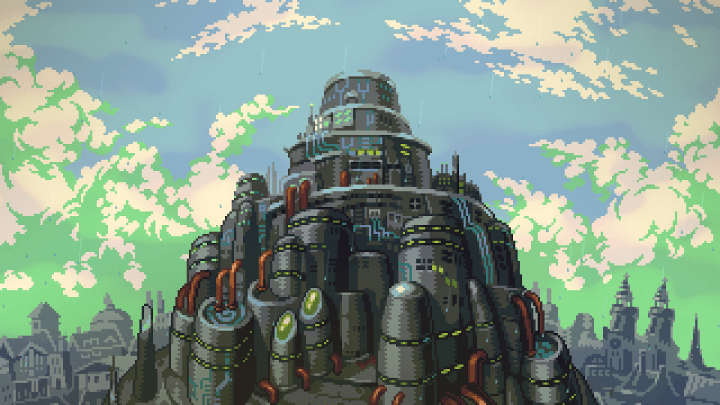
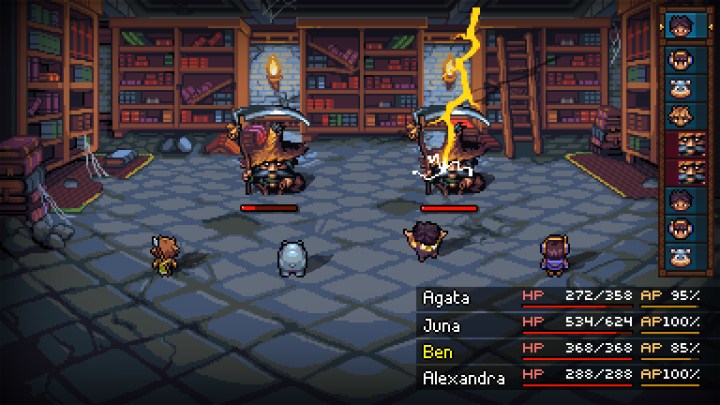
Quartet exemplifies the pixel-art charm of true retro-era JRPGs, particularly from the Super Nintendo period. Environments are well-crafted and varied, showcasing cities, rocky valleys, lush forests, and tranquil gardens with great attention to detail. However, the game’s visual fidelity is inconsistent. Some character sprites, NPCs, and enemies rival those in Chained Echoes, while others appear more basic, resembling clusters of pixels roughly arranged into humanoid or creature forms. The simplicity of the sprites also limits emotional expression through facial animation, slightly reducing immersion. Nevertheless, the overall visual presentation remains vibrant, nostalgic, and effective.
Audio
One of the standout features of Quartet is the audio suite. Its soundtrack has impressive range and is beautifully composed, with each track capturing the appropriate mood from wild to whimsical, somber to serene, and intense to introspective. Silence is also used to great effect, allowing key narrative moments to breathe. Too often, games overuse music, but Quartet knows when to let quietness amplify emotion. The sound effects are equally well executed, enhancing both atmosphere and gameplay.
Gameplay
If you’ve played a JRPG in the SNES-era mold, Quartet will feel immediately familiar. The gameplay is straightforward, traditional, and truly turn-based. Players navigate overworld maps and local environments, entering battles that unfold in a clear turn order displayed on-screen. This transparency allows for careful planning. Party members can be swapped in and out mid-battle, similar to Final Fantasy X, adding a welcome layer of tactical flexibility.
Characters level up by earning EXP, gaining HP, AP (the equivalent of MP), and improved stats tailored to their roles. They also learn new skills at certain levels. While these systems don’t innovate, they are well executed and provide consistent satisfaction and reward for effort.
Challenge
The gameplay of Quartet might not be anything new, but the challenge factor of the game is definitely a standout attribute. The game offers both Normal and Hard difficulty modes, with Hard providing a genuine test of skill. Every action in combat matters. Exploiting enemy weaknesses is essential, buffs and debuffs are often critical, and enemies are dangerous from the start. The result is a rewarding sense of accomplishment that deepens immersion and makes victory feel earned.
Replayability
The strong writing and memorable cast make Quartet a story worth revisiting. The inclusion of eight playable characters and the ability to switch them freely in battle add depth and variety. However, since all abilities remain accessible throughout, later playthroughs may feel repetitive unless players impose self-challenges, such as restricting their party composition. The ability to choose different origin stories at the start or replay on higher difficulty does help maintain replay value.
Accessibility
Thanks to its adherence to classic JRPG conventions, Quartet is easy to pick up and play. The mechanics are intuitive, and the game offers helpful tips to guide newcomers. It’s approachable for beginners while still satisfying for veterans who crave classic gameplay structure.
Personal
At first glance, Quartet may seem like a spiritual successor to countless JRPGs about unlikely heroes uniting against a tyrannical regime. Yet beneath its nostalgic surface lies a deeper, more nuanced story that tackles uncomfortable but relevant themes. Few games invite such genuine introspection about the human condition and our place in the world. Each character’s story demonstrates that people from all walks of life can influence society for better or worse—a message that resonates far beyond the fantasy setting.
It’s true that there are too many games and not enough time, so it’s harder and harder for the smaller fish to make ripples in the gaming ocean. Fortunately for us, some games can not only breach the surface but really give us something that endures in our minds for quite a long time. Quartet delivers a top-quality experience that longtime JRPG enthusiasts and new fans can all enjoy in equal measure. An enthralling story, an excellent cast of characters, a fascinating world are all complemented by the skillful work of the visual and audio design teams to make a contribution to your JRPG library that you can keep coming back to. Something old really can be new again!
Thank you to Something Classic for supplying us with a copy of Quartet for this critique.
 The-Pixels
Leave a comment